Author: Roger Bergson

  • Five Cities, Five Distinct Personalities: Ravenna

    We added Ravenna to our travel plans because Carol took a class on La commedia (in italian, where the language is not capitalized, only the first word in a book title is capitalized) over the Winter.  Of course, the prof’s name was Beatrice.  Our September travels  were primarily dedicated to un giro da la vita di Dante – a trip about the life of Dante.  He was exiled from his beloved Florence at about 23 years old and lived in Verona among other places.  The charges that resulted in his exile were trumped up, and he was judged while in Rome on a diplomatic mission that many scholars believe was set up to get him out of Florence so he could be falsely accused of misappropriation of civic funds.  This was about 1303.  La commedia takes place after he was exiled, but he does not directly talk about it.

    Dante’s daughter, Antonia, later joined a convent in Ravenna. The author lived the last 20 or so years of his life there.  And, for the purpose of our trip, it is also where the great man is buried.   What we did not know is that the entire month of Sept is la festa dantesca, the Dante festival, as that is the month he died.  Not much was going on the two days we were there, but Carol would like to return with better knowledge of possible events to attend.  There were Dante readings in multiple languages, including Hungarian.

    Dante’s original burial site
    The place of honor

    Paying homage at Dante’s tomb


    We did find something really interesting for us.  The city of Ravenna is old.  It was once the Western capital of the Roman Empire.  Since then, it hasn’t seen much fame, other than now as a world heritage site for Roman mosaics.  We weren’t quite as keen to go from mosaic museum to mosaic museum as some, but we did locate Domus tappeti di pietra (carpets of stone.)  In the 1980s a man was digging a hole to build a garage.  The earth caved in and archeologists discovered a 14 room roman home, with amazing mosaic floors.  Today, a tourist can walk on elevated platforms from room to room.  One huge room was geometric designs with representations of the four seasons dancing in the center. That  sight alone was worth the trip to Ravenna.  We also visited a mosaic workshop where several people were painstakingly making copies of the ancient works.  

    Superman works to re-create “Superman”
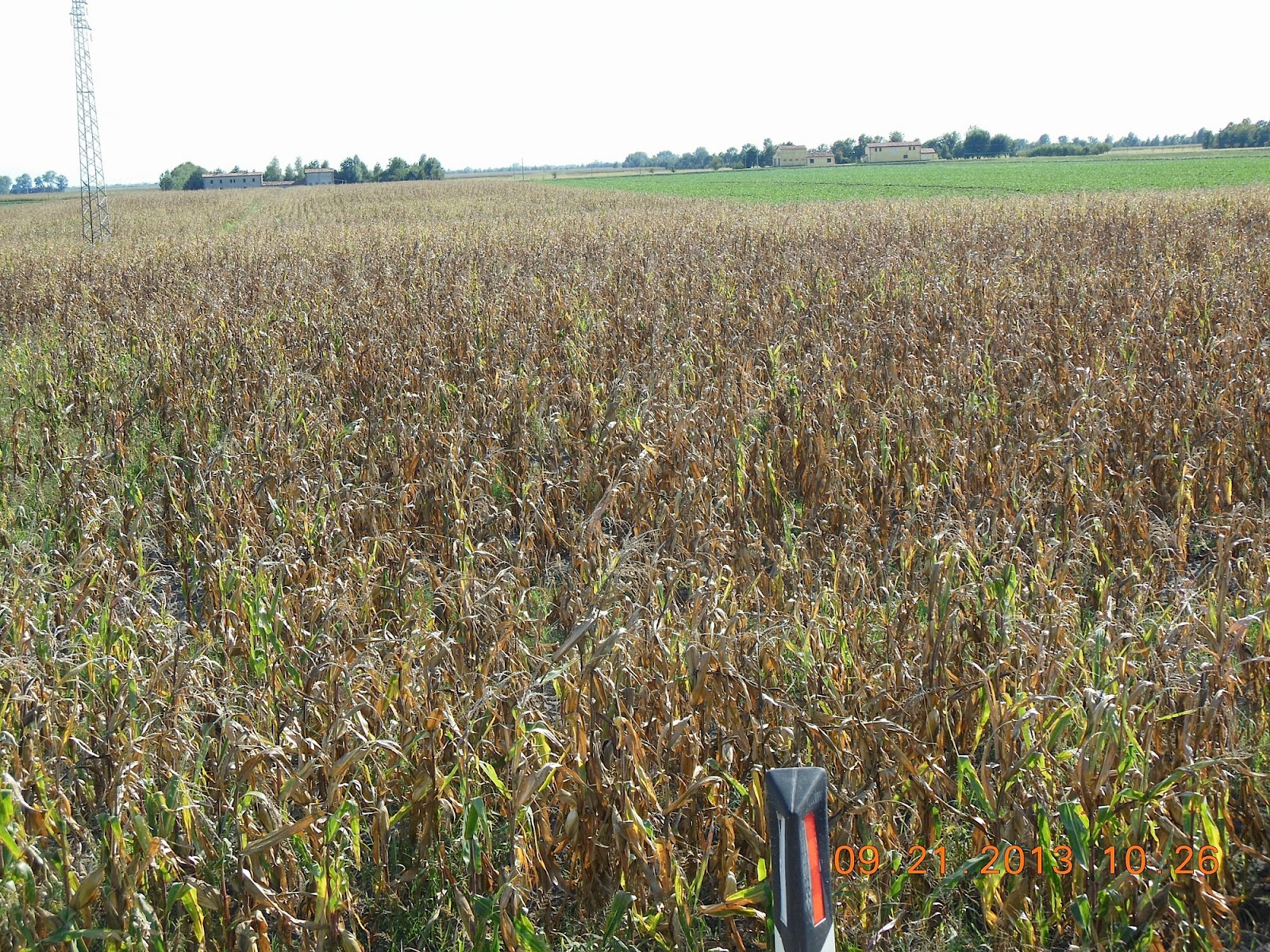
    The ride to Ravenna was lovely.  We skirted the Po Delta, as we didn’t have time to ride through it, and with lots of water, innumerable roads which most likely didn’t have signs on them, and a hot day, we would have spent hours trying to find our way out of the maze.  Instead, we road through more farmland along canals.  We were nearly consumed by biting insects of various sorts, and had an all-around great ride.
    Where the Po flows into the Adriatic
    The delta makes a nest of dead-end roads


    The only way to cross is on a small, rope-tow ferry


    Other than those two activities, we walked the streets for hours, one of our favorite past-times.  

    And you thought Pisa had the only leaning tower.

  • Five Cities, Five Distinct Personalities: Ferrara

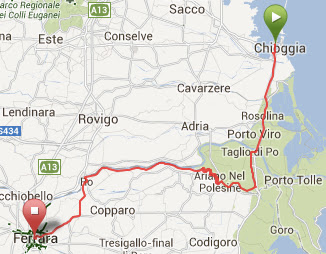
    The road to Ferrara was to be a long one…120 km.

    We left early on a Sunday morning to avoid the traffic on a very busy highway.  We were told no semi’s were allowed on the road until late Sunday evening.  What we experienced was a reminder that in Italy what’s allowed and what actually happens rarely resemble one another.  The first vehicle to pass us—and almost blow us off the road—was a semi with tandem trailers.  For the most part however, our first 25km weren’t all that bad.  At that point we got off the main road and onto a strada provinciale (a provincial road, which are typically without trucks and not a lot of traffic at all.)
    The road was flat, much of it (80km) along a bike path built atop the levee of the River Po.  About 12 years ago Destra Po (right side of the Po) was developed for biking and walking along the river.  It is part of a national park.  Of course, if there is a Destra Po, there is also a Sinestra Po (Left side.)  You guessed it.  We weren’t smart enough to figure out there would be TWO bike paths where we got on – which was of course also the only place you could get on one or the other and after the sign indicating such.  We got on Sinestra Po and rode about 7km towards Venice, to the north, before meeting a young couple out for a Sunday ride.  When we asked them about places for lunch up the trail, they informed us we were on the wrong trail!  Surprise, surprise.  We rode back with them to where the trail split, the correct trail going over a bridge at that point.  They were very nice, and it was about the first time we had seen a young couple riding together.  Very few woman are out here on anything other than city bikes for grocery shopping, etc.
    Commune of Ferrara, not the city, which we entered about 5km further up the road.
     It felt nice to get to our destination.

    Ah, Ferrara.  We were last here 13 years ago.  The city has changed dramatically, and while not to our taste, the local folks are most likely very happy with the “upgraded” ambience.

    Our studio apartment was in a renovated 12th
    century castle.    

    A typical street
    Another typical street


     The medieval city of Ferrara was protected by a surrounding wall…most of which is intact…and can be walked on today.  We walked a LONG way on the wall one afternoon to visit a ceramica, a factory where ceramics are made in the traditional style of the 14-1600s.  We bought one piece of theirs when here last, and it is one of our favorite pieces.
    Never has there been a city dominated by one family like Ferrara.  The Dukes of Estes ruled Ferrara for hundreds of years.  They left their imprint on everything.  The Castello Estanse dominates the old city (We visited the Castello 13 years ago, and Carol had me thrown in the dungeon):
    Este Castle, right smack in the middle of the old city.
    We tried to find a single palazzo or church that did not bear the Este name.  
    Diamonti Castle.  There are over 7000 pyramid-shaped stones on the front of the castle.
    Those few that didn’t turned out to have been built by Este nephews or in-laws.
    The Estes were remarkable because they exerted influence throughout Italy totally out of proportion with their power base.  They managed to pull this off by waiting until the big power players deadlocked and then threw their support to the winning side…for a price.
    They were also very good businessmen.  Early on, one of the Este dukes needed money and so invited some impoverished Jews to his city to act as money-lenders.  The Jews became prosperous, and the city thrived along with them…developing one of the first capitalist economies in Europe.   A good read that partially takes place in Ferrara and is about Spanish Jews forced to flee is The Secret Book of Grazia dei Rossi.  
    A street in the old ghetto.
    In 1492, when Ferdinand and Isabella expelled the Jews from Spain, Ercole d’ Este invited them to Ferrara.  A good number came…giving the economy and the community a shot in the arm.
    Carol at the old “Spanish” synagogue.
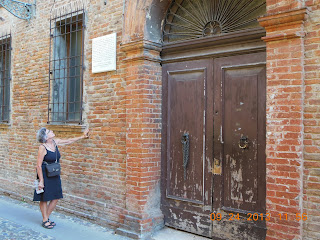
    The plaque at the Spanish synagogue telling the story of the Estes’ invitation of the Jews to Ferrara.
    UNESCO named the Ferrara ghetto a World Heritage site.  The community grew and prospered until 1944, when the Nazi’s shipped much of the population off to concentration camps.  Ad, speaking of books and authors, that story was made famous in the novel and movie, “In the Garden of the Finzi Contini.”  Giorgio Bassani wrote a number of other novels and short stories, all taking place in Ferrara.      The author of that novel was born in Ferrara in this house.  It is across town from the ghetto.
    Bassani’s house, with a plaque telling who he was and that he lived here.
    Look who visited the University!
    Below is a photo of one of the Estes, at the entrance to the Piazza del Popolo (Piazza of the people.)  When it was last renovated, the column was made from tombstones taken from the Jewish cemetery.
        
    …and at the end of the day…
    The end of Roger’s “work” day

    The statue

    The sign that says that in 1927 when the statue was redone, its base was made from tombstones in the Jewish cemetery.

    When last there, Ferrara felt like a small town, even with a substantial tourist population.


    Add caption

  • Five Cities, Five Distinct Personalities: Chioggia

    We reluctantly bid farewell to Antonella and Padua and headed out for Chioggia.  By car, it’s a simple 50 km, but to avoid major highways, we took the longer and scenic route and turned it into a 84 km jaunt.

    The roads were flat.  The biggest challenge was avoiding the dead-ends caused by all the canals that inter-laced the Po delta.


    You’ll see from the map, Chioggia is 45 km south of Venice.  The main gate into the city tells the story of who ruled the town for centuries before Italian unification.

    Like it’s more famous neighbor to the north, Chioggia is a city of canals.

    View towards the other city in the lagoon

    The principal difference between the two cities is that Venice is a tourist haven and Chioggia is a blue collar fishing village.
    ,Dinner in a fishing village

    The main street is loaded with restaurants and shops to appeal to the few tourists they do get.  But if you cross one of the bridges, you end up in quiet and charming working-class neighborhoods, where the food is just as good and the Aperol Spritzes (called spritz aperol) are half the price, although the snacks are not as fancy, but great with aperol on a warm night.

    Sit down, kick back and enjoy twilight, the real thing

  • Five Cities, Five Distinct Personalities: Padua

    If Verona is the city of love, then Padua is the charming university town.  And, students have not changed their nature since we were among them.


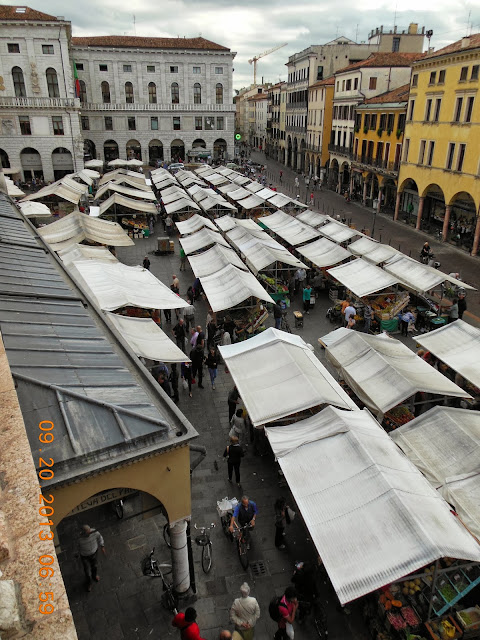
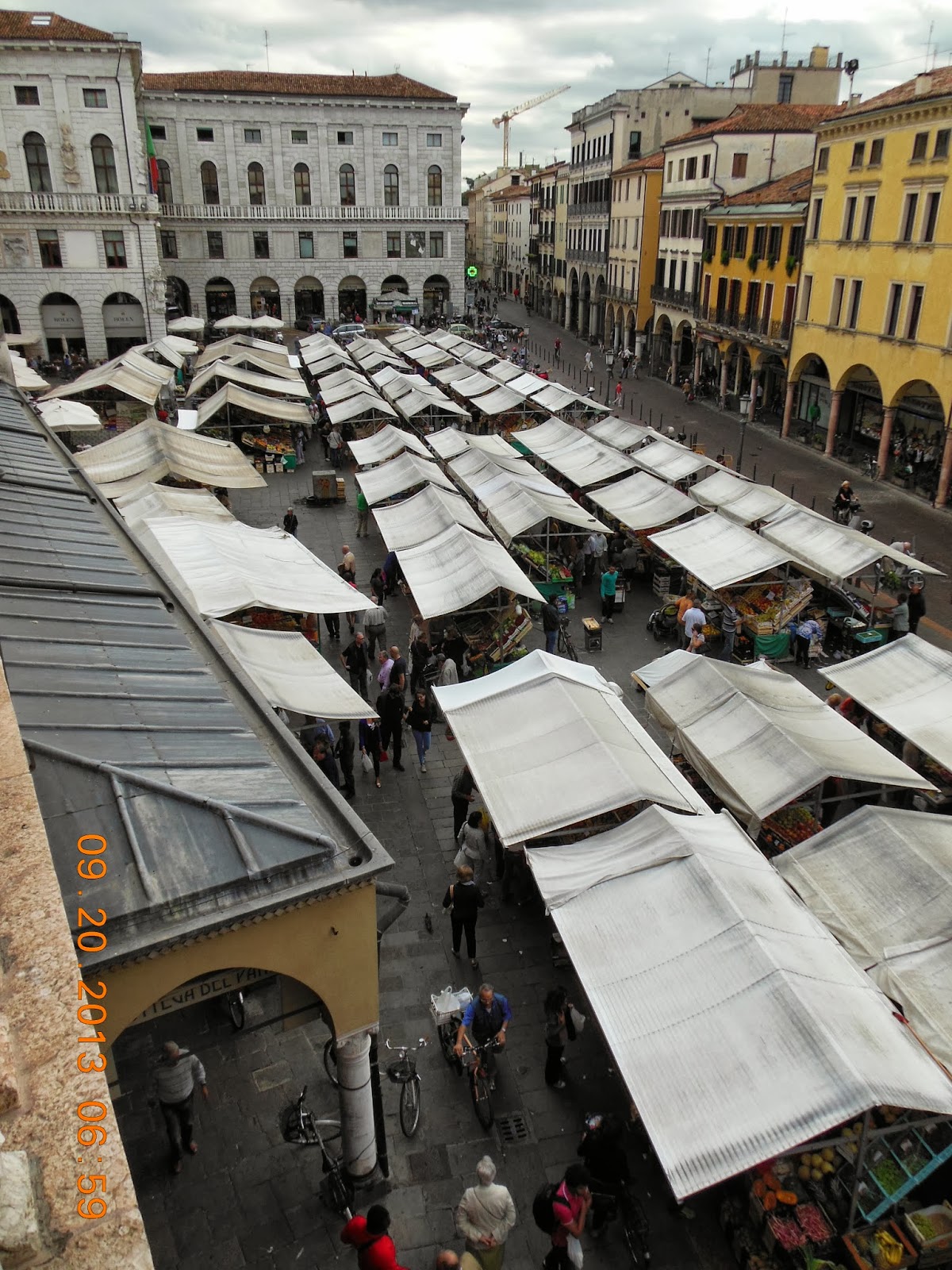
    Piazza  di Erbe

    Our hostess in Padua was Antonella…

    Outside the apt with Antonella.

    …a vivacious and amichevole (friendly, with any positive attribute that goes along with it.)  She is in her mid-70s and nearly skips up the three flights of stairs to the apt.  The apartment was just lovely.  It is where her grandmother lived and she grew up there, as well.  Antonella and her husband now live across the street.  The apt is called Al Canton dei Signori   Should you wish to visit the city, I would highly recommend staying there.  As with any place we choose to stay, it is in the centro storico (historic center) of Padua, just off the Piazza Erbe.  Also, we do not stay at any inn, B&B, albergo, agriturismo or other spot not owned by Italians.  It’s a conscious choice to support the citizens of the country we are visiting, and to actually be in Italy with Italians.

    And here is the street of the apt, with a little street art.

    We spent two days prowling each and every street in Padua.  There are surprises everywhere.

    A random building on a random street

    A Monestary garden

    And, like in other cities, pigeons were not welcomed.

    To prevent pigeons from landing in public places, under porticos, etc.

    And there are lots rules from people, too, always posted.  This posting is near ruins of the Roman Theater in Padua.

    There are multiple piazze (plural of piazza) in the centro of any city, all very close to one another.  Always, a Piazza della Republica, one for the cathedral, and often one for a clock tower.  Padua did not disappoint!

    The clock tower in the Piazza Erbe contains the oldest functioning clock in the world.  While it was not the first clock built in Eurpoe, it was the first to keep accurate time.

    The clock face is a bit unusual.  It has 24 hours, and the clock has only one hand…

    Note the coat of arms of the Republic of Venice, a winged lion, just below the clock face.

    In the Piazza della Populo is Palazzo della Ragione (Palace of Reason, i.e., the courthouse).

    It was built in 1172 and houses what is still the largest roof unsupported by columns (267 feet long) in Europe.  How big was this room?  Take a look…

    The horse—made of wood—was sculpted in the 1450’s to promote a trade fair.  The sponsors liked the sculpture so much they decided to keep it.  The only place large enough to store it was the “Salone,” the great hall on the second floor of the Palazzo.

    The roof of the building was contructed like the hull of a ship and was then lined with a ceiling that was painted with thousands of stars on a blue background.  All that wood, guess what?  There was a terrible fire and the roof burned.  When reconstructed, it remained a wooden hull only.  Still, it’s size is just amazing.

    The walls are covered with frescos of seasons, zodiac signs, people, you name it.  It is a huge room, so there was plenty of space for a wide variety of frescos.

    There was also some fun street art.  The students are a bit political here, although to tell the truth everyone is up-to-date on current events.  Sitting at an outside bar, one overhears at least one conversation about politics in Italy, one about international politics, one about love, and more than one in a Germatic language which neither of us understands.  We are up north after all.

    We had no idea there was a ghetto…

    or that there would be any signage.

    Like Verona, the former ghetto has become an upscale shopping district.

    The  Italian Rites (Ashkenazi) synagogue was destroyed by the nazis during WWII, but was rebuilt by the city following the war.

    Front door of the rebuilt synagogue
    Even the portal was rebuilt
    It is no longer used as a place of worship, but around the corner we heard men in morning prayer.  
    The Spanish (Sephardic) synagogue is still operating. We, make that Carol, was not allowed to go inside…not only because she’s a woman, but that day she was sleeveless.  There was a man at the door to keep people out and two policemen.

    Safe

    http://3.bp.blogspot.com/-E-…
    http://3.bp.blogspot.com/-E-y3Zd…
    Feel free to open this page.
    Click here to check the URL yourself.
    Trend Micro Page Rating
  • The Grand Mis-Adventure

    This was supposed to be a year of cycling, right?  Well, we’d been in Italy more than a week and hadn’t gotten on our bikes yet.  But that time was drawing near.

    We had taken the train from Firenze to Verona.  The stop at the station in Verona was short, and we had to hustle bikes and luggage off the train.  We were in a rush, but got everything off…or so we thought.  As we were leaving the train station, Roger realized he had left his helmet behind, and the train had left the station.  Fortunately, we knew of a bike shop a few kilometers outside the city, and  we needed a shake-down ride anyway.  And why did we know of a full service (very unusual to find it all under one roof in Italy) shop?  Five years ago we had gone to Verona to do some biking and Carol’s suitcase, which had all her biking gear, did not arrive with us.  British Airways had no idea where it was and after four days gave us permission to purchase new gear.  The suitcase arrived on day 8 with Hawaii inspection stickers all over it.  It had had a great time in the island state and we had found a good cycling/running shop.  Anyway….

    We dressed for the ride, and as Roger went to put on his bike shoes, he discovered he had pulled two right shoes from his luggage in Chiusi, and left both left shoes in the bags which remained with our Pienza host.  So, wearing no helmet and street shoes, Roger set off with Carol to the bike shop in San Martino, just outside Verona.  Since it was the end of the season, nobody had any inventory left.  Nonetheless, we found a serviceable helmet and pair of shoes.

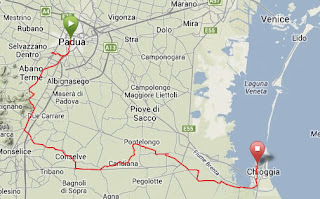
    The next morning we set out for Padova (Padua).  It was a simple 85 kilometer ride we had done before.  However, thanks to an amazing number of roads with no signs noting where they were going, multiple signs for the same small towns and directions from locals who only drive from place to place and like to take the scenic route to get there (read that:  they visit all their friends in multiple towns on their way from point A to point B), we managed to turn an easy 85 km into 115 km of starts, stops, and generally being “solo un po’ persi” (only a little lost.)

    At least the Po Valley is flat.  In 115 KM, we climbed a grand total of 74 meters.  The biggest hill was an overpass over the A4 Autostrada.  The Italians call this, “piano, piano (flat, flat).”  Here’s what it looked like in one direction:

                      ..and in the other….
    A few miles from Padua, we were pedaling  down this pleasant country road.  Light traffic.  Well-marked.  Suddenly, with no warning, the road morphed into a major freeway…the ever-popular Autostrada.  We were terrified but kept on pedaling…because we didn’t know what else to do.  Just when it seemed things couldn’t get any worse, they did.  That freeway joined another, and we were trapped in the middle of four on-ramps with no idea where to go.  Just then, a police siren blared…seemingly from within Carol’s back pocket.  An Italian cop got out of his patrol car, ran up to us and said, in English, “You can’t ride your bicycles here.”  We explained how we got there.  He told us to ride 2 km to the next exit, and get off.  He’d follow in his patrol car, blocking the speeding traffic from killing us.  So with his lights flashing, he crawled behind us to the next Autostrada exit, hitting the siren and going to our right to block an on ramp and then again as he blocked the off-ramp.  At the bottom of the ramp, he motioned for us to turn left and jumped out of his patrol car to give us directions to the historic center of the city.  Throughout all of this, he was really nice, a smiling and very friendly young man.  Carol wanted to hug him and give two kisses, one on each cheek – this is a two kiss part of Italy, there are three kiss regions, as well – but all he would allow was repeated “mille graze” (a thousand thanks.)  We know this was not the first time he had seen “pazzi turisti” (crazy tourists) somehow end up on the Autostrada.