Category: Uncategorized

  • Five Cities, Five Distinct Personalities: Bologna

    27-30 settembre
    We arrived in Bologna with great expectations.  Many years ago we had spent part of one day in the city, mostly at the cathedral square.  One of our parents’ friends, also the father of one of Carol’s high school chums, had gone to medical school in Bologna as the Nazi racial laws prevented him from completing his education in Germany.  He had many fond memories of the city and had told me about it before we came here the first time.  Bologna is the home to the first university in the western world, founded in 1088.
    Unlike the university in Padua, these students are both serious leftists and a scruffy crew.  There were lots of facial piercings, died hair, and generally a UW ’60’s look about them.  There is graffiti everywhere outside of the prime tourist route in the historic center of the city.  We have no idea what happened to the photos of some of it.  
    The city is great to get around in during the rainy season, as many of the sidewalks are covered with poritcos.  They started as an illegal method of extending the first floor over the street.  (Ground floor, then first floor in Italy.)  You’ll see them in most of the photos.
    This is the building where our apartment is located.  
    Our apt building

    We’re on the top floor with a really sweet terrace for chatting, breakfast, and drying laundry.  It was our first air bnb experience and was wonderful.  We shared the apartment with a young couple, about our kids’ ages.  By quirk, they are both book people:  He was a university librarian until the economic downturn and she works in a bookstore.  Francesco is very nice.  Cristina loves English literature and kids books.  We had a great time talking about books, Italian and American authors, adult and kids’ books, in both English and italian, although her English is better than my italian by miles.  We caught them without warning in the kitchen, preparing breakfast.  
    Cristina e Francesco in the kitchen

    We hope they come to visit us in Pienza, as Cristina is starting a new job at Eataly in Firenze Nov 1.  We are about an hour by train from there.  In their apartment we had a bedroom and private bath, they have a loft bedroom and bath.  I fondly remember their living room and dining area, as they are about 3 times the size of ours.  Tasha and Nathaniel, you have to move fast, as they may have more books in their shelves than you have!


    A little about Bologna’s sights:
    The old synagogue no longer exists.
    The ghetto is fairly well marked, with several maps posted at strategic locations.  It was easily blocked off by its narrow streets and a canal.  More about canals later.
    The old synagogue has no sign, but it’s address was on one of the permanent maps, which we could not photograph as they were covered with graffiti.

    This is what the Pope thought of the Jewish population

    Bolgona was founded on a  site with three rivers.  Over time, the city grew over them.  Now, they can be viewed briefly flowing in open air at several locations throughout Bologna.  We found two of them.  One is considered a romantic 
    Near the ghetto, the canal comes to the surface.  
    viewpoint, although we didn’t get that, unless you want a photo of yourselves with a canal in the background, going through a historic neighborhood…not pretty, but it is water flowing in a city.

    Roman wall with canal visible through grating
    The other viewpoint for one of the rivers is through Roman ruins at the edge of the historic center, actually, almost across the street from the train station.  It was only drizzling when we got there.  More about rain to follow.  
    Another view of the Roman wall


    Speaking of Roman ruins, there is a typical type, although amazing find, in the very center of the city.  Like the guy digging out for a garage in Ravenna,   The Salaborsa is a cultural treasure open to the public.  Descending a broad stariway,  you are transported back to the 11th century BCE (BC).  Walking on raised platforms, visitors view wells, sewers and building foundations from early citizens of the area.  By the roman times there is a basilica foundation and road pavements.  There are 13th century residential foundations, and a 14th century brick well.  By the 16th century there are cisterns and structures which appear to be hydrophonic tanks.  All of this is under what had been a palazzo, but is now administrative offices and a few high end shops including a coffee shop where you can sip you espresso while thinking about the 2200 year old town under your walking shoes.  
    Folks above us can look through glass strategically placed inm the floors and see these archeological wonders 
    A little more on the cultural theme.  One evening as we sipped our spritz aperol and nibbled potato chips and olives, a group of actors in full costume – it was hot that day – came by advertising Rigoletto which would be done later in the week, after we left Bologna, by a local opera company.  We chatted for a few mintues, which was fun.
    At the same time, the streets in central Bologna were closed that day to motorized vehicles and while it was not a formal festa or sagra, there were a lot of performers and food going on.  There were demonstrations of cheerleading!!!!, America football!!!!!, judo, tai chi, ultimate frisbee (the freestyle frisbee tournament was the next weekend, darn) and dancers dong tangos, flamenco, and other types of dancing that I can’t describe.  Performance groups set up street coverings – you would not want to dance on cobbled streets) and individual and pairs performers simply found a space to do their thing.  The woman below

    Half of a two person band/puppet show

    was incredible, as part of a two person band/puppet show.  We couldn’t get close enough to get multiple or better photos, so use your imagination.  The main square, Piazza Maggiore, was packed with people all day and night.


    Crowds, troppo gente (too many people)


    We all know about the leaning tower of Pisa, and perhaps are aware that there are two famous towers in Bologna.  Here they are.  They are the Asineelli and Garisenda Towers.  The story is that due to a family feud, two young lovers were denied marriage.  The woman jumped to her death from one tower following the death of her beloved.  Sound familiar?  Towers were built for defense.  Rarely was there an entrance at street level, but rather an entrance would be 20 feet or so up the tower.  To get there, one had be invited into the home of the owner, be escorted upstairs and then cross by a temporary wooden bridge that could be pulled into the tower in times of defense, or into the house during more peaceful episodes.  Each family built its tower higher than the others.  At the base of another tower in the neighborhood there is a shop that has been in operation since the 1700s, although with a variety of owners and goods.


    Giacomo Leopardi, a wonderful 19th century poet whose collection Canti we read in class a year ago, lived here.  When I think about how the city must have looked then, and the surrounding area, I can understand why his verses are based on roman references and look back to the perfection of the past.  It is flat here, no hills to climb, vistas to view, or sunsets floating over the mountains.  You can see what appears to be a never ending field ahead and behind, a continuity of time and place.

    After 18 days of nonstop sightseeing, eating and occasional riding, we were to take a hike with Francesco, Cristina and some friends/relatives on our last day in Bologna.  Instead, we woke up at 6:45am to a horrendous rain storm.  Great day, on a number of levels, to hunker down and read.  Our hosts went out mid-morning to visit family.  The only reason we didn’t stay in our jammies all day was that we had none.  We did curl up and read, venturing out to an osteria a block away for lunch and across the street for dinner.  The rest day was truly a treat.  
    A few more photos.
    One of the gates to the city
    Entry to the medieval museum
    A city street.

    Next stop Bocaccio’s hometown, Certaldo…

  • Climber’s Delight


    On Sunday, October 13th, Carol and Roger set out to explore a town we’d never been to….Campiglia d’Orcia.  Little did we know what we were in for.  On our map of the province, Campiglia showed as a hilltop town, but then so did most of the other towns in the area.  As we approached, the town didn’t even look that high.  The surrounding hills towered above it, primarily Mt Amiata, the highest mountain in Tuscany.


    We turned off the highway onto the road that approached the town.  The first two kilometers climbed gently.  Then we turned a corner, and bang!…the road pitched up to an 8% grade (remember in the USA, a federal highway can’t exceed a 6% grade).  In the next 6 kilometers, we climbed 467 meters (1,530 feet).  As the road approached the number 2 on the map (where the squiggly line is) the grade hit 13%, then 14%…and stayed that way for a full kilometer.

    Carol…just a few hundred meters from the top of the climb


    Turns out, this was a Cat 2 climb.  (For the non-cyclists among the readers,  climbs are rated by their length and pitch…with Cat 4 being the least challenging—though usually a knee-breaker—and Cat 1 the most…for professional cyclists, not amateurs in their late-60’s. 

    We took no photos in Campiglia d’Orcia.  We were too exhausted.  We grabbed a quick bite to eat in a local bar and set out for the 40 km we still had to go to get home.  Several years ago, Roger had cycled to the town of Castiglone D’Orcia and thought it the hardest climb he had ever done.  As we pedaled out of Campiglia, we realized we would be going downhill to reach Castiglone, mostly riding along a ridge with 360 degree views, should either of us decide to actually stop and look.

    The ride along the ridge-line was beautiful regardless.  As we approached Castiglone, we could see the old fortress dominating the horizon.


    This fortress was built in the mid-13th century by the Picolomini family, after they were run out of Siena.  It was the same family that founded Pienza.  The original fortress is a ruin, since replaced by a “new” fortezza in the 16th century.  The same Sensesi who went to Radicofani for self-defense (last blog) also came here for protection.

    Carol at the “new” fortezza
    With a final push, we got home…63 km later, having climbed 1324 meters (3822 ft for you non-metric types).  Actually, we felt great when we got back to Pienza.  It was a good ride, even if we were not quite in shape for it yet.  Plus, our post-ride gelato was fabulous!  Three scoops each for our efforts and for the three climbs of the day,including the climb into Pienza.


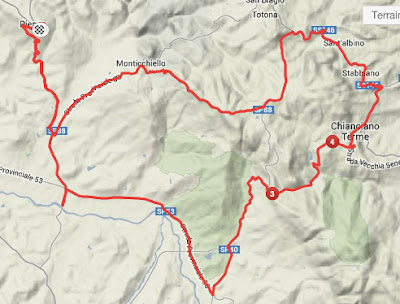
    As if that weren’t enough, we decided the next day to find a new route to Monte Oliveto Maggiorre, a lovely monastery famous for its series of 13 Signorelli frescos.  We were trying to avoid the hill into Trequanda…that climbs at an 18% grade.  (Greg and Ruth, remember that one?)


    Again, we found a beautifully scenic route that was new to us.  If you look at the map above, you’ll see it has six—count ‘em, six!—Cat 4 climbs.  There was one climb of 15%, two of 14%, two of 13%, and one of “only” 12%.  


    You’d think we would have learned our lesson the day before.  It did feel really good to get off our bikes back in Pienza, although Carol needed a wall for support after getting off,  entertaining two well-dressed tourists.  Even though our usual gelato shop was closed today, we found another and had wonderful tubs-o-gelato .  It’s a wonder the gelato shop would let us in wearing clothes that were so puzzolenti (smelly!!!!)


  • La Rocca


    The highest inhabited point you can see from Pienza is the town of Radicofani (pronounced Radi-co-fahn-ee).  It’s about 20 km from Pienza as the crow flies but 35 km by car.


    The hill seems impossibly high.  We find it hard to believe that when we were younger, we rode our bikes to the town…twice.

    This time, we got a ride with Seattle friends Rebecca Fox and Bob Heller, who stopped by to visit for a few days.

    Trying to decide whether to start an antique car collection


    The town has a distinctive look.  All the buildings are stone with horizontal stripes of brick.


    What makes the town unique, however, is the fortress that towers over everything…atop an impossibly steep hill.


    In 1253, the rebels from the losing side in one of several Sienese civil wars, fled Siena and perched upon the highest hill they could find to defend themselves.  Over the next few years, they built a fortress as further defense.

    The signs in town told us it was a 15 minute walk up to the fortress (La Rocca).

    It was a 15 minute walk
    …for a mountain goat

    The fortress is almost 800 years old and still standing.

    Inside, the pictures tell the story…

    The cistern to store water in case of seige

    Carving over dungeon entrance


    And…as always…the view from the fortress to the valley below wasn’t too bad…

  • La Foce

    La Foce is a place Carol always wanted to visit.  Until today, we never had made it there.
    La Foce is the southern-most point on the map
    Today’s ride was 54 km with 1,109 m of climbing (more than a kilometer!).  For the cyclists among you, that included two Cat 3 and one Cat 4 climb.
    The story of La Foce is the story of Iris Origo.
    Iris Origo was born to a wealthy Long Island family in 1900.  She was raised in a former Medici villa outside Firenze.  She married the son of a prominent Roman banker, and together they bought a barren estate just outside Montepulciano…La Foce.
    The entrance to the estate
      

      They completely rebuilt their house.  They rebuilt the houses of their impoverished tenant farmers, built a health clinic and a school where there had been none.  The land had been over-farmed for centuries.  The soil was so poor, the tenant farmers could barely scratch out a subsistence living.  Using modern soil conservation techniques, they restored the land to productivity.

    During WW II, they secretly aided the partisans, and hid downed Allied airmen.  In the two decades after the war, many of the tenant farmers joined the leftist political parties or moved to the cities to find work.  The wheels came off the tenant farming system all over Italy.  La Foce was no exception.
    However, La Foce kept its world-famous formal gardens.

    Carol at the gardens


    Iris Origo’s grand-daughter now runs the estate as an upscale Bed and Breakfast.


    Telling the La Foe story to a pair of Canadian cyclists.
    And the view from the B&B isn’t too shabby.

  • The Town with No Name

    Yesterday morning we tempted fate, hoping to get a bike ride in before the next weather system pelted us with yet another thunderstorm.  We succeeded.

    We were trying to ride to La Foce…a small village revitalized during the 1920’s by an American woman and her Italian husband.  More of that story when we actually get there.

    We never made it to La Foce…dead-ended by roads where the pavement ends.  Instead, we wandered around and found perhaps the most beautiful ride we’ve yet encountered in Tuscany…which is saying quite a lot.

    The ride first went to Montecchiello, a tiny village with one of the two best restaurants in the area.
    After leaving Montecchiello, we got our bearings right and decided to extend the ride (it turned out to be 50 km long with 820 m of climbing) with a visit to what Pienzans call “the town with no name.”
    Pienza lies at the north-east entrance to the Val d’orcia.  San Quirico at the north west.  Either can control access to the whole valley.  They have been arguing and fighting over it for centuries.  The rivalry is so fierce many native Pienzans refuse to utter the name “San Quirico.”
    Consequently, we wanted to see what made the town so horrible.  Take a look:

    The main street

    The Duomo

    The commercial district
    The community rose garden
    …and…
    The view on the ride home.