Category: Uncategorized

  • Thomas Jefferson’s Inspiration

    Andrea Palladio was born in Padua, Italy in 1508. At age 13, he moved to Vicenza…a wealthy city on the northwest frontier of what was then the Republic of Venice… and apprenticed to a stone cutter. Eventually, he became a master cutter, then a project manager.

    In Vicenza, he learned to network with the city’s elite…and was soon hired to design several palazzi and villas for the city’s wealthy.

    In all, Palladio designed 23 palazzi in the city of Vicenza and another 24 villas across the Venetian Republic.

    Collectively, they have been named a UNESCO World Heritage site.

    In the midst of all this design work, he wrote “The Four Books of Architecture,” which survives today as one of the most influential works on architectural theory of all time.

    What is it that made Palladio unique among Renaissance architects and made his legacy unequaled to this day?

    Doric columns, lintels, cornices, loggias, pediments, and domes were all used before Palladio applied them to his designs. But he had a sense of proportion and a vision of spacial harmony that none of his predecessors possessed.

    Many of his projects were updating the facades of existing building or were constrained by the footprint of a villa he redesigned. That he could incorporate these limitations in designs and yet break new ground is why he is still considered a genius five centuries later.

    Back when Carol first studied Italian at the University of Washington, she did a project on Palladio, and it kindled a love of architecture that lasts to this day.

    So there was no way that she and Roger could travel to the Veneto and not visit a number of Palladio’s most famous villas.


    Villa Emo:

    Villa Emo is a classic Palladio villa. When Leonardo Emo commissioned Palladio to design this villa, the extended family owned hundreds of acres of farmland. The existing building was inadequate for the family’s needs, so Palladio was hired to replace it.

    The new villa is three stories, the ground floor was functional space…kitchen and wash areas.

    A large stairway leads to a columned loggia with an entrance that leads to the piano nobile…where the family lived and conducted business.

    The top floor was used for storage and servants’ quarters.

    The two barchesse…the wings to either side…were for storage and farm implements…though later were repurposed for family quarters.


    Villa Maser:

    Daniele and Marcantonio Barbaro commissioned Andrea Palladio to design this agricultural estate around 1550.

    While the house looks large from a distance, it is only when you get up close do you begin to appreciate its grand scale…

    That tiny-as-an-ant creature standing next to a middle column is Carol.

    At the left end of the barchesse is a sundial to tell the time of day…

    At the opposite end of the other barchesse is a sun calendar…with the symbols of the zodiac instead of the months we now use.

    Behind the main building is the highly-decorated nymphaeum. It served a dual use…at once a quiet social space and same time the controller of the villa’s household water supply and garden/greenhouse irrigation system.

    Inside the villa, the walls and ceilings are covered with frescoes by the Venetian Renaissance master Paolo Verese.

    At the end of one set of rooms is a fresco of Verese’s wife. Note how Palladio’s use of perspective frames the painting with doorways through three rooms.


    La Rotonda:

    There is a hill just outside Vicenza called Monte Ciello.

    This is the place where Paolo Almerico chose to build his country home. He hired Andrea Palladio in 1565 to design the villa.

    And…this is where Thomas Jefferson got his inspiration for his home (not coincidentally) called Monticello.

    La Rotonda is different from other villas in several ways. It combines the features of Palladio’s other country homes with design elements of pagan temples from ancient Rome. And it was designed for a single resident, rather than a family…which gave Palladio freedom to use living and work space differently.

    Inside the villa, it’s something else.

    Frescoes everywhere…

    The inside of the dome is glorious…

    …a small detail of one of the many panels in the occulus.

    This decor is clearly post-Palladio, but it is indicative of the opulent life-style of its residents over the centuries.

    It’s easy to see how Palladio’s sense of spacial symmetry and geometric balance influenced Thomas Jefferson when he designed his own Monticello….

    the University of Virginia,

    and influenced other architects who…

    …designed a few other well-known buildings in the United States


    Teatro Olimpico:

    Palladio never got to see his final project completed.

    The Accadamia Olimpico, a group of cultural intellectuals in Vicenza, hired Palladio to design a theater for their use in 1579. He completed it’s design…

    …in 1880,but died before the construction of the theater was complete.

    The many niches surrounding the stage hold statues of prominent members of the academy.

    Sophocles’ Oedypus Rex opened the building in March of 1585 …making the Teatro Olimpico the oldest indoor theater in the world that’s still in use.

  • They Start ’em Young

    The first weekend in September in Pienza is the Fiera del Cacio (Cheese Fair). This year was the 64th edition…an homage to the town’s principal product, Pecorino di Pienza.

    Sunday morning culminates a week of activities. The opening event is the running of the sheep, a much smaller…and safer…version of the running of the bulls in Pamplona, Spain.

    The afternoon festivities started with an exhibition by the town’s sbandieratori.

    The short video at the right is best seen full screen


    (We have written many times before about the history and development of the flag throwers.

    For the development of the art, see:https://rbergson.org/sbandieratori-flag-wavers/

    For an exhibition of several different sbandieratori teams, see: https://rbergson.org/563-years-later/)


    The sbandieratori were followed by the headline event. Each Pienza contrada (neighborhood) sends a team of six cheese rollers. The competition, a combination of horseshoes and bocce, has each contestant roll a 1 kg wheel of cheese over a bumpy 500-year old pavement to see who can get the wheel of cheese closest to a bowling pin.

    [see: https://rbergson.org/pienzas-own-palio/ for our post on last year’s event]

    All of this led Carol and Roger to wonder, where do the Pientini learn these skills?

    The answer is: they start ’em young.

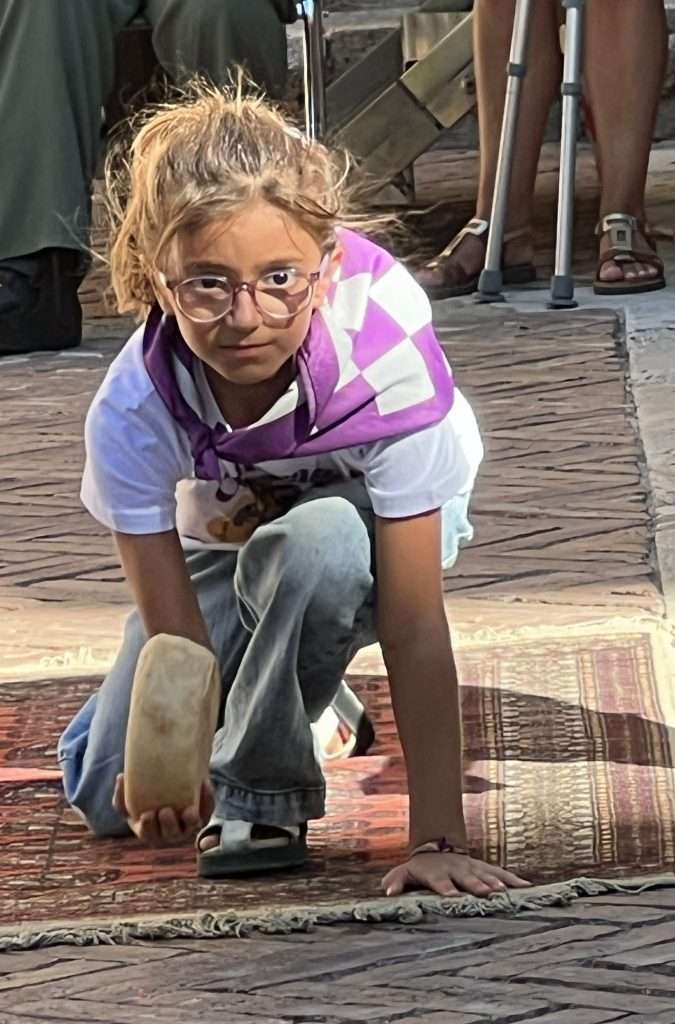
    Each contrada rercuits its own giovani (youngsters). Many practice for years before making the neighborhood varsity.

    Some don’t do too badly in their rookie season, and some need a bit more practice.

    (Again, this video is best seen expanded to full screen)

    Gruppo Musici e Sbandieratori Pienza  is a community organization that trains both the flag throwers and the drum corps whose rhythms support them.

    The drummers start learning the ropes by the time they’re barely old enough to attend school.

    Same with the young sbandietori…

    (Remember, expand this video and the next to full screen)

    …though it will take years more practice before they are as proficient as their elders.

    In a world in which lots of the Pienza teens we see dream of escaping to life in a big city…especially New York…it’s refreshing to see so many of the children eagerly participating in the traditions that make life in this small town so special.

  • The Magic Jacket

    Ten years ago…when he was a bit more svelte…Roger purchased this very fancy rain jacket for cycling.

    It was made of the latest miracle fabric that kept the rain and wind out while at the same time it wicked away perspiration.

    But that wasn’t what made it magic.

    In 10 years of cycling in Pienza, Roger never ever got caught out in the rain when he packed the jacket along on a ride. Should he leave the jacket at home on a cloudy day, he always got soaked by a sudden rainstorm.

    That was the magic.

    As Roger’s 80th birthday approached, he was determined to squeeze in a birthday bike ride regardless of the weather. The forecast didn’t look promising. It called for a 70% chance of rain. When he woke up early birthday morning, the forecast predicted rain starting in four hours. The bike ride he had planned took only three hours, so he decided to give it a go.

    From Pienza, Roger headed north to Trequanda. As he approached Trequanda, the sky darkened, and a light rain began to fall. Was this the end of Roger’s lucky talisman?

    Within a minute, the rain let up, but the sky continued to darken.

    His next destination: Montisi. Even though it’s only a few kilometers away, it was slow going…two big hills along the way.

    From the top of one hill, Roger could see rain in the distance.

    In Montisi, it was time to stop for an espresso at a bar called L ‘ Ombelico del Mondo (The Bellybutton of the World). Roger walked in the door…this photo was taken in better weather…and the skies opened up! A 15 minute rain squall, and then the sun came out.

    Roger pedaled on to Torrenieri in bright sun. His luck had held.

    But as he was leaving Torrenieri, he looked to the west. The sky was black. Soon, he saw lightning bolts to his right and heard the rumble of thunder behind him.

    By the time he approached San Quirico d’Orcia, the thunder and lightning was nearly constant. It was only 2-½ hours since Roger had left Pienza. Clearly, the weather forecast had been overly optimistic.

    He ducked into the cover of San Quirico’s Porta Cappuccini…named not for the coffee drink but for the Cappuccin order of monks who once lived nearby. (This photo of the gate was also taken in fairer weather.)

    Roger again checked the weather forecast on his cell phone. This time, it predicted heavy rain would start within minutes.

    How heavy was it?

    From under the protection of the porta, Roger could look up the street into town. About 5 minutes after his arrival, he saw gutters overflowing with rain runoff.

    This deluge kept up for half an hour, until the rain eased enough so the downspouts could hold the water.

    Soon thereafter, the sun came out, and Roger hopped back on his bike and pedaled home to Pienza.

    That jacket is truly magic.

  • European Heat Dome

    Carol’s and Roger’s bags were packed, and they prepared to leave for Pienza, one thing was on their mind…all the stories they had read about surge after surge of extreme hot weather across Europe.

    On the day of their departure, the New York Times published a map along with a story about how extreme heat has plagued Europe all summer

    They had read the weather reports for Tuscany and were warned about what to expect when they arrived.

    Despite this, they weren’t prepared for was what they found when they arrived at the airport in Rome.

    They hopped in their rental car and headed north to Pienza. Roger looked at the dashboard and noticed the outside temperature read 44°C…

    …that’s 🔥111°F🔥.

    When they arrived in Pienza, Carol and Roger found many things the same. The Piazza Duomo was as pretty as ever.

    Carol’s friends were still there for morning coffee….

    We noticed the tourists all got out of the sun to take their photos.

    Miraculously, the flowers on our terrace had managed to survive the heat…but only because a friend came to water three times a week.

    Gas prices show the effects of world events. The price shown on the sign is per liter…the equivalent of $8.40 per gallon.

    Carol and Roger did catch a short break. Just as they arrived in Pienza, the sky filled with with thunderheads.

    Soon, the thunderheads turned into a drenching rain…with lightning that lasted for hours.

    When the rain let up, Roger went to move the car. The temperature that had been 44° C now read 24° C…a drop from 111 °F to 75 °F.

    The relief proved temporary, however. By the following morning, temperatures were right back up to the new “normal”… with a forecast high of 102°F.

  • Sneak Preview

    (this blog post was written November 28th, but had to be embargoed until the new year to protect our hosts from violating Consorzio rules.)

    After aging patiently in the barrel and bottle for five years, the 2021 vintage of our very favorite wine, Brunello di Montalcino, is almost ready to go to market.

    The Consorzio di Brunello’s rules prohibit its members from releasing the latest vintage until the January five years after the grapes are harvested.

    However, in late November the Consorzio di Brunello hosts:

    This marketing event…open to distributors and credentialed wine press…is timed to meet deadlines for the world’s wine magazines (e.g. Wine Spectator or Wine Enthusiast), so articles about the latest Brunello vintage will come out just as the wine is first available for sale.

    It’s four days of wine tasting….

    … presentations about how weather shaped the 2021 vintage….

    …or master classes on convincing restaurants to carry more Brunello on their wine lists

    (Thanks to SienaNews for these convention photos)

    However, the real marketing is done at private dinners, where wineries fete journalists to elegant meals in an attempt to get them to write positive reviews.

    Carol and Roger would have drooled at the opportunity to attend.  But there was no way.

    Imagine our delight, then, when our friends at Azienda Agricola Innocenti invited us to drop by a few days after Benvenuto Brunello for a chance to preview their 2021 vintage.

    Patrizia Gallorini did the honors.

    First, the 2020 Brunello…for comparison purposes.

    Then the new vintage…2021.

    Note, the bottle has no label. Brunello vintners can’t label their wines before the approved sell date.

    So, how does the 2020 vintage rate?

    Our expert’s face tells it all.