In June, the streets of Pienza are naturally festooned with flowers.
But one day in particular, the Pientini go out of their way with a lavish display of “floral opulence.”
The day is called “Corpus Domini.” It dates back to the Middle Ages.
Religious in origin, the celebration has taken on all aspects of a civic event. Acquaintances of ours, who almost never attend mass, eagerly participate in the decorations.
Corso Rossolino, Pienza’s main street, is decorated from end to end with freshly harvested leaves and flowers…
…as is every side street in the old city.
Some of the designs are very intricate.
Half the children in town seem to be involved with the decorating…
…or wetting down the flowers to prevent them from wilting in the summer heat or being scattered by the breeze.
It seems to Carol and Roger like an awful lot of work for something that lasts only a few hours. But the civic spirit and sense of community is one of the things that makes Pienza such an appealing place to live.
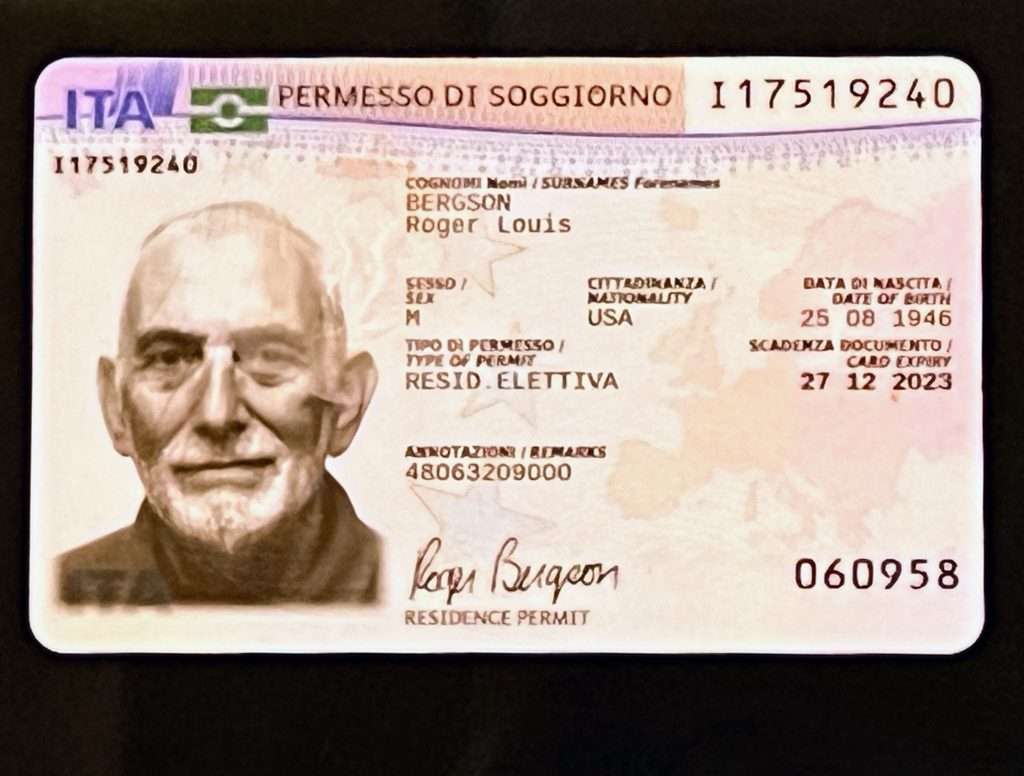
This is the document that makes a foreigner a legal resident of Italy…a Permesso di Soggiorno.
Carol and I got our first Permessi in 2017. We had renewed the cards twice since without problem and believed we were starting to get the hang of it.
So, we didn’t think much…back in September 2023…when it came time to renew again.
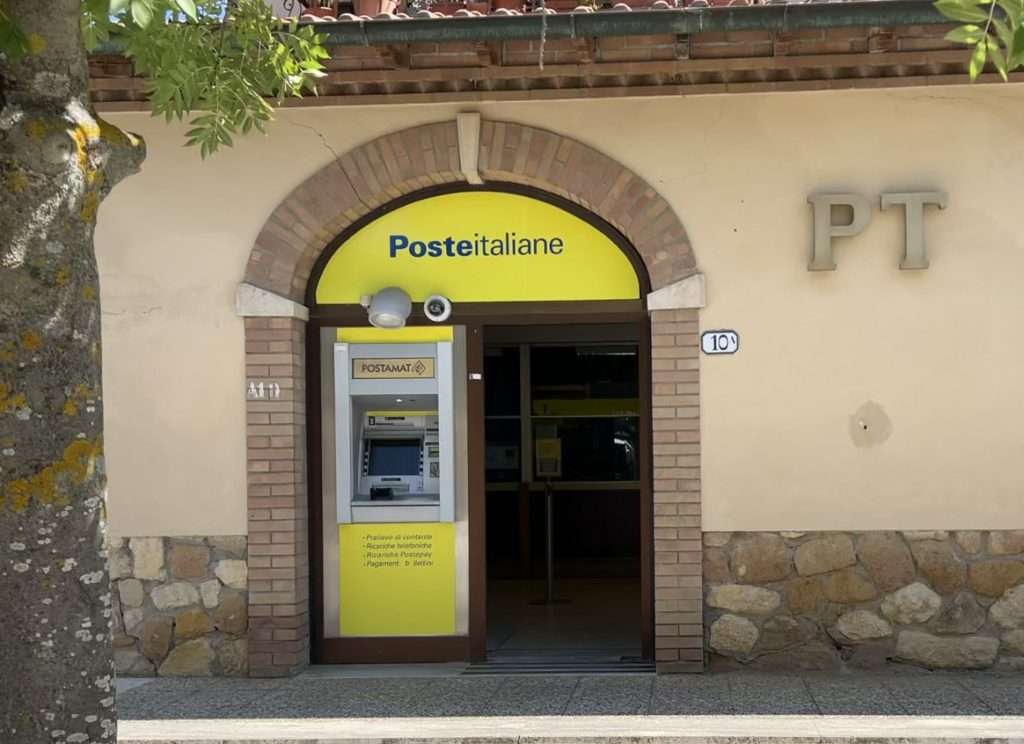
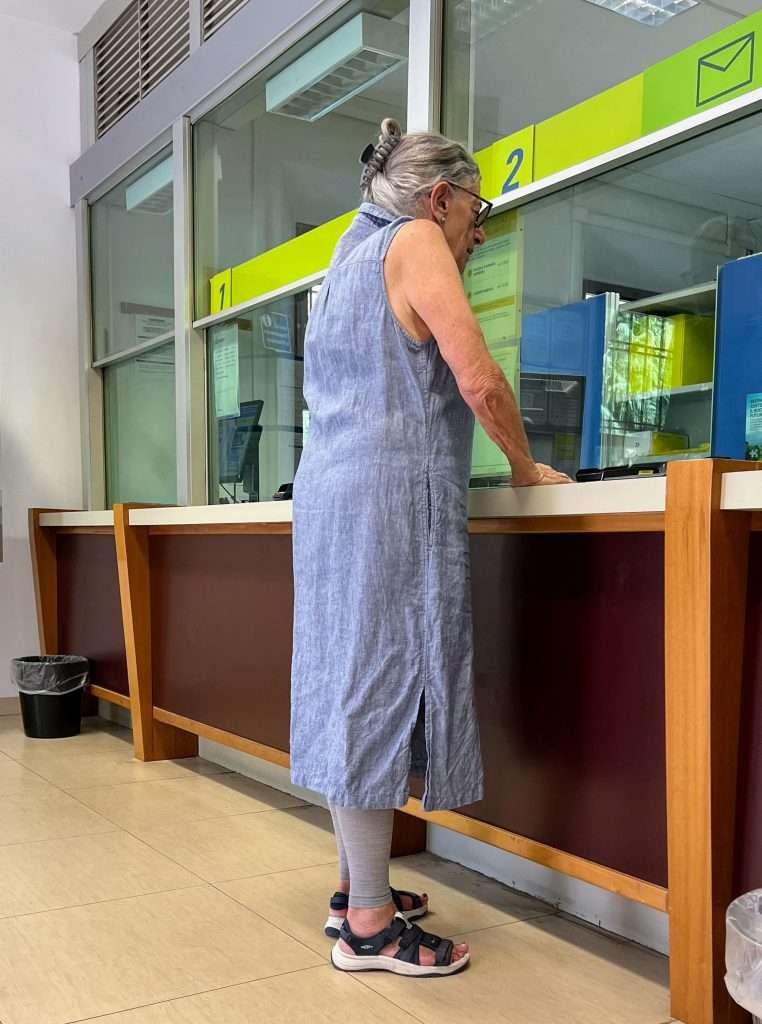
The process starts here, at the local post office. The application packet is hefty, and requires pages and pages of additional documentation… proof of income, assets, health insurance, residence, and a bolletino to pay for processing.
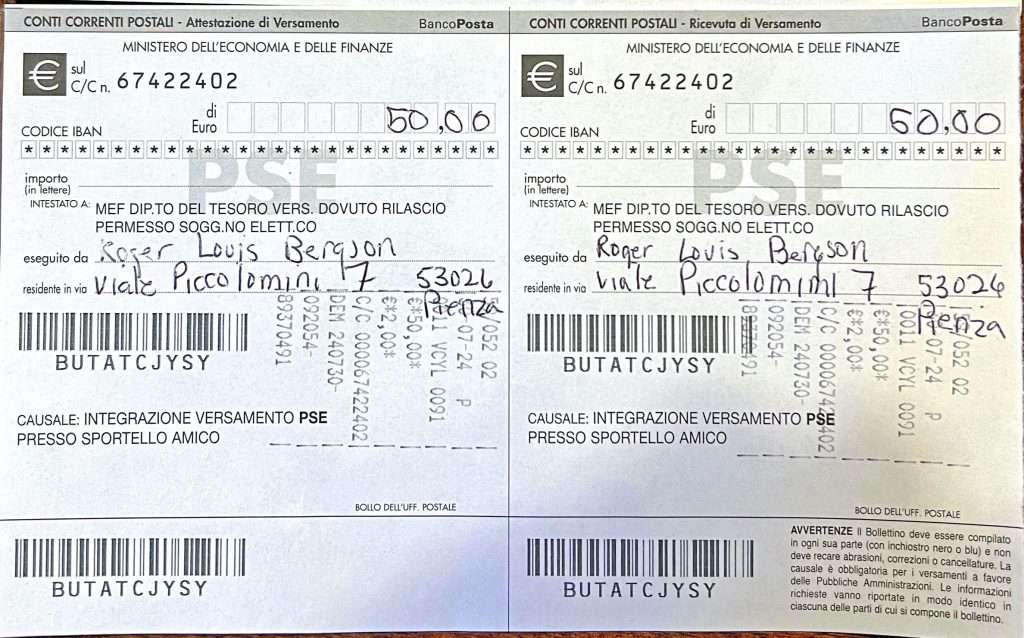
A bolletino is a tax stamp. So, you purchase it at the Post Office, right?
Nope!
Anybody familiar with the Italian system knows you purchase stamps at the local tabac (tobacco shop).
Please notice the computer printing on the tax stamp shown left. It’s verification the bolletino was properly submitted.
This will be important later.
Carol returned to the post office to submit our applications. Along with the receipt showing the applications were received, we got appointments for mandatory in-person interviews.
The appointments are supposed to come within 8 weeks of application submittal.
Not in this case! Our interviews were scheduled almost 20 weeks out…after we were due to leave the country and spend the winter in Seattle.
Carol contacted the Questura di Immigrazione to reschedule and was told to hang onto the appointment document and ask for a new date after we returned.
In May of 2024, we returned to Italy. Note the expiration date on the Permesso di Soggiorno had passed. We were no longer legal residents but perfectly legal tourists…so long as we departed the EU within 90 days of our arrival.
Shortly after our May return, we received a document telling us we finally had an appointment the end of July. We went, expecting to pick up our Permessi.
Instead, we found that we needed to submit a copy of two additional bolletini and Roger’s health insurance card. Once that was done, we were told, our Permessi should arrive in Siena in less than a month
We submitted the necessary documents the next day.
By the middle of October, having heard nothing and past our time as legal tourists, we began to worry and decided to revisit the Siena Questura.
Since we had no appointment, we stood in line for more than two hours…finally helped by the same policewoman who had assisted us in July. She told us our applications had not been processed because the second batch of bolletini had not been submitted. Carol asked if the office in Rome had received Roger’s proof of health insurance (they had!)…at which point Carol showed her the one email that contained both the proof of insurance…and the “missing” tax stamps!
Apparently, the bolletini had somehow gotten “lost” in their files.
She forwarded that email to Rome, and said in slightly more than three weeks our Permessi would be in Siena.
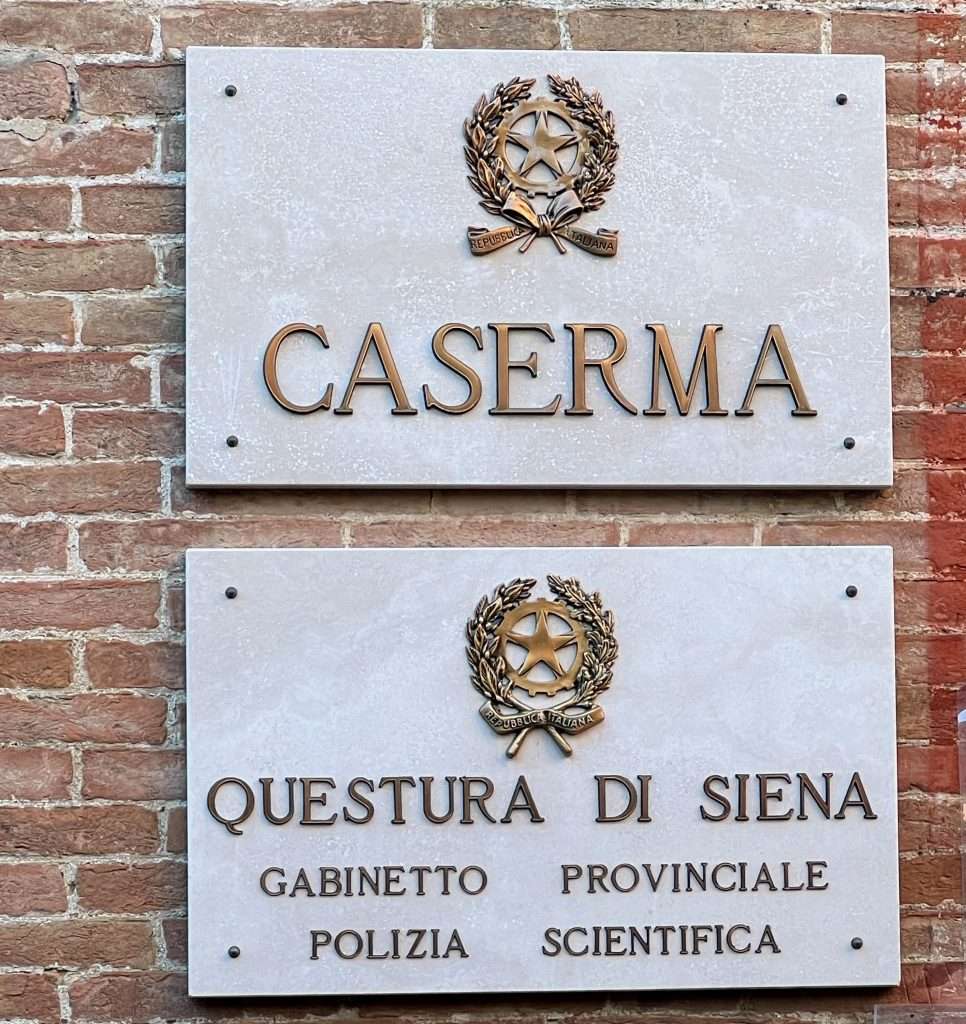
Meanwhile, we went next door to the Police Science Lab to get fingerprinted…since a fresh set of prints is required with each new Permesso card.
Carol monitored the Immigrazione website almost daily. Our documents continued to be labelled “in process.”
Until one day they weren’t.
In mid-November, all of a sudden our applications had a new status: “no longer in archives.”
We panicked. What did this mean? Carol called and emailed the Questure in both Rome and Siena…several times a day. Nobody ever picked up the telephone and the emails were never returned.
We hired an immigration attorney to see what he could find out. He got no answers to his inquiries either.
We now had a new problem. Since we had overstayed our tourist time and didn’t yet possess our long-overdue residency permits, we were in legal limbo. We had planned to fly back to the USA with a stop-over in Denmark, but our questionable legal status now prevented that. We had to find a country that was not party to the applicable international treaty and fly through it.
Carol called the US Consulate in Firenze seeking help. The official she spoke to apologized that he was prohibited from offering advice. He told her, however, to hang onto his phone number and call in case we were arrested and detained trying leaving Italy.
On our way to the airport in Rome, Carol and Roger each got a text. The Questura di Immigrazione in Siena now had our completed Permessi. We finally had an appointment to come pick them up…the day after we departed Italy
We contacted the immigration attorney to tell him the news. He offered to go to the Siena Questura and pick the Permessi up. We accepted his offer and thanked him.
After returning to Seattle, we wrote the attorney asking how he planned on forwarding the residency cards to us. He told us, the police would not give him the cards because they did not have copies of our fingerprints…the same fingerprints they had recorded just a month before!. Another two documents lost in the morass of Immigrazione bureaucracy!
When we returned to Italy the end of May this year, we promptly headed up to Siena. After another two hours of standing in line, then being told nobody could help us because we didn’t have an appointment, we finally begged our way into the office. And…
Voila!
We received our new residency cards…
….only618 days after we started this process.
Notice the expiration date on the card: December 2025! In a few weeks, we’re going to have to start this adventure all over again.
Postscript: One of our friends…an American living just outside Siena…had very little sympathy for our tale of woe. She told us when she retired and applied for Social Security, it took her five years battling the American bureaucracy before she got her benefits.
When Carol and Roger got to tour the Pope’s palace in Pienza again this year, they also got to see another special treat…
….the Renaissance’s first encyclopedia.
Some historical context to start with…
Before he became Pope, Enea Silvio Piccolomini was a Vatican diplomat.
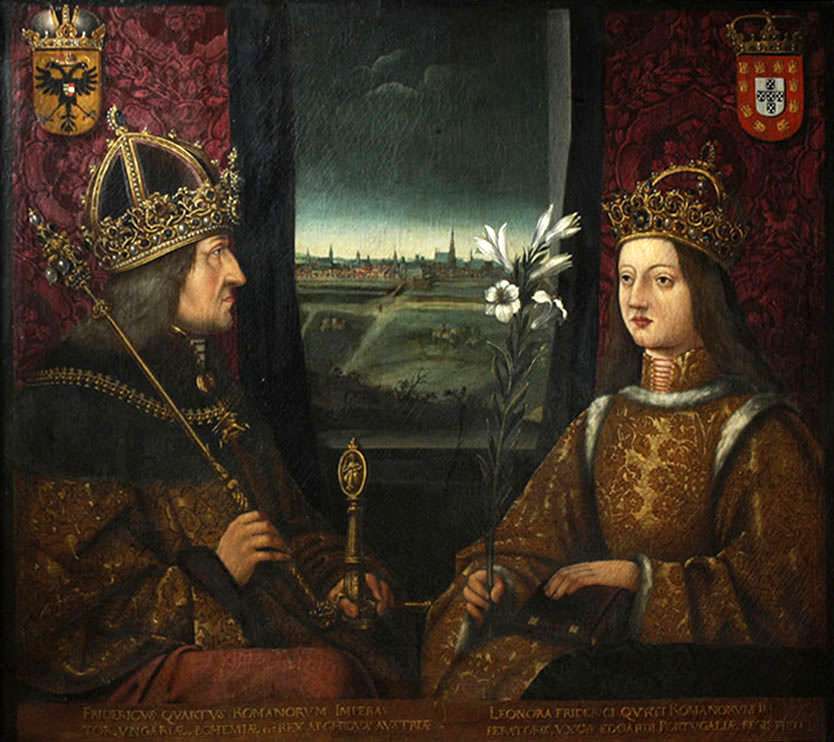
One of his notable achievements was arranging the marriage of Frederick of Hapsburg to Eleanor of Portugal…
…thereby assuring the loyalty of both the Hapsburg (Austrian) and Portuguese crowns to the Church.
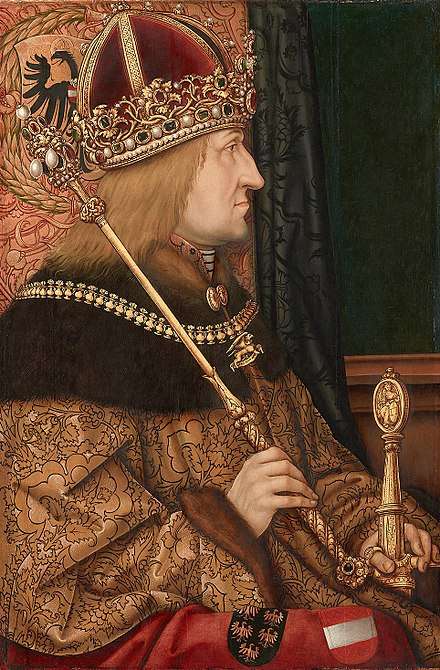
When Frederick became Holy Roman Emperor (1452), he named Piccolomini “Poet Laurate of the Holy Roman Empire” and his personal secretary.
So, there was a long personal relationship between the two men.
Enea Piccolomini became Pope Pius II a few years later and served as Pontiff until his death in 1464. Frederick III served as Holy Roman Emperor another 30 years.
To honor the man who arranged his marriage and served as his private secretary, Emperor Frederick III decided to publish an encyclopedia of the known world.
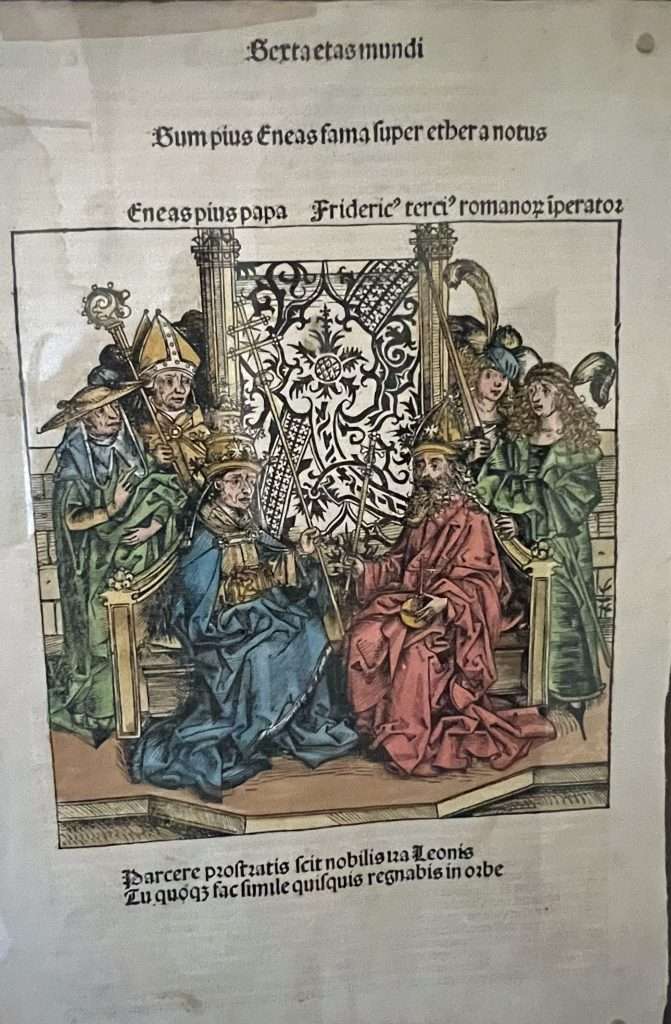
The encyclopedia is known as “il Libre Cronicarum” (The Book of Chronicles.) The German language edition was released in 1493, the Latin version a year later. It may have been the first book published in Europe to contain both text and drawings on the same page.
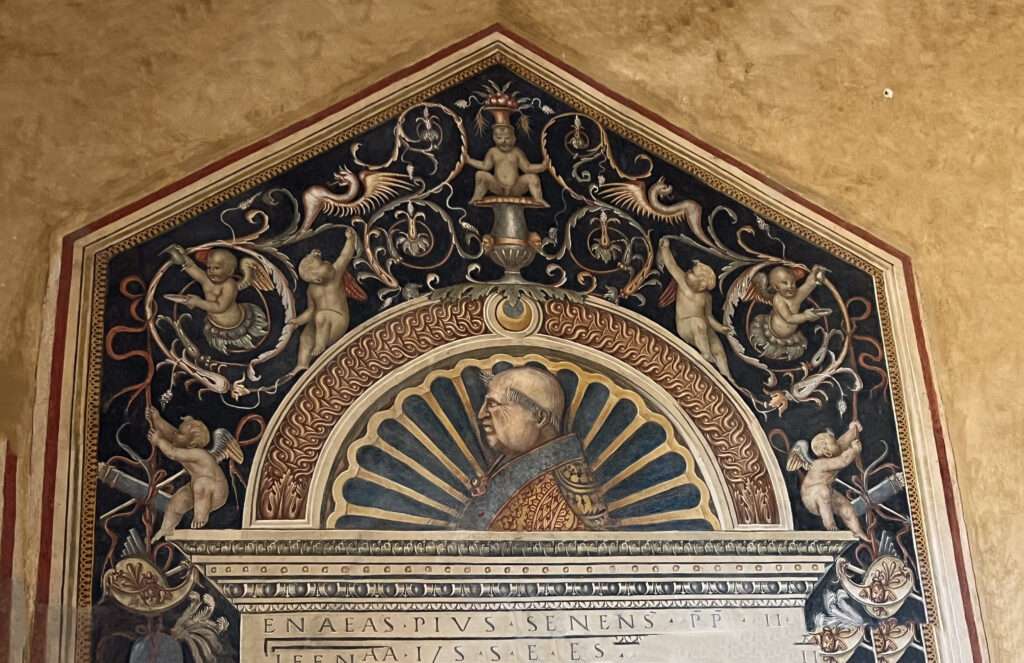
Lest you think Eneas Piccolomini was not the inspiration for this book, notice the dedication above the picture (“Eneas pius papa“) and who is standing behind Empress Eleanor in the wood-block print.
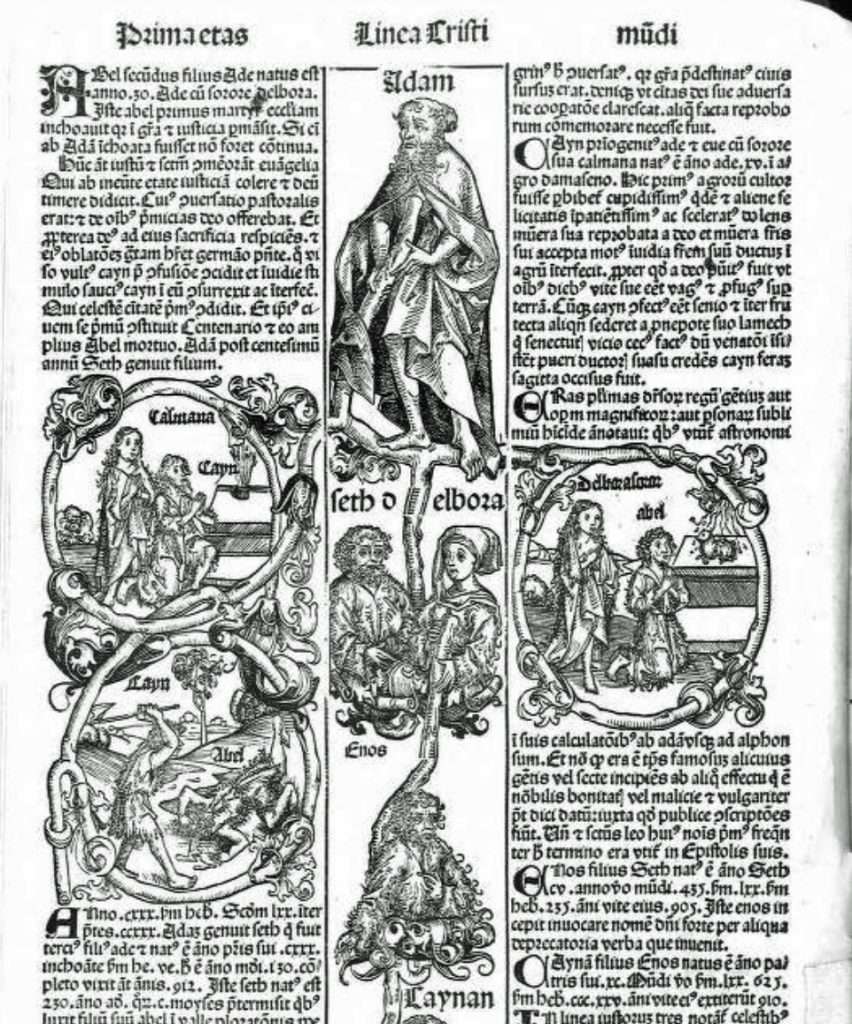
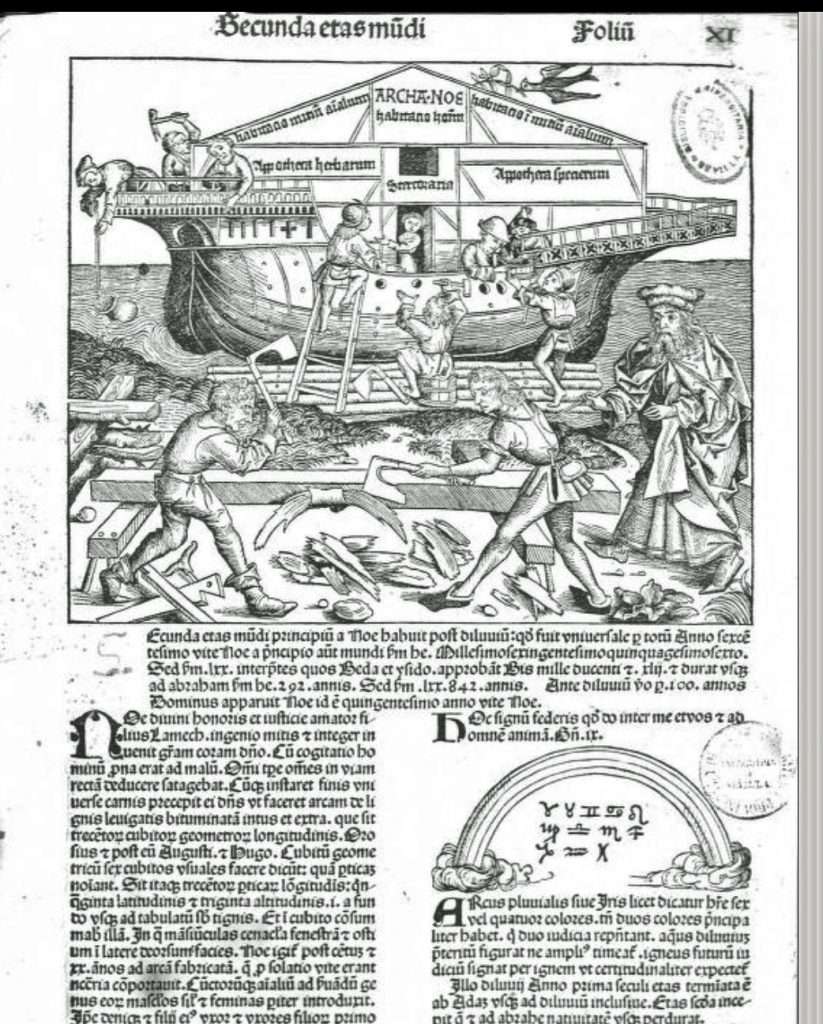
The first pages of the encyclopedia are a “biblical history” of the world…
…starting with the creation of Adam,
…the building of Noah’s Ark…
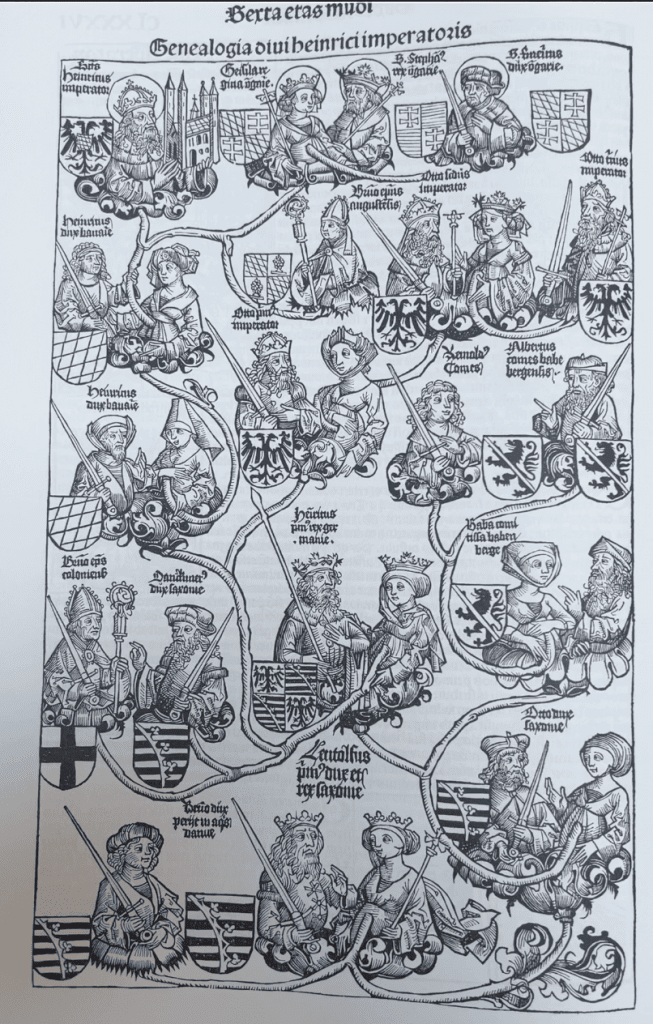
…and extending to the geneologies of Europe’s then-ruling families.
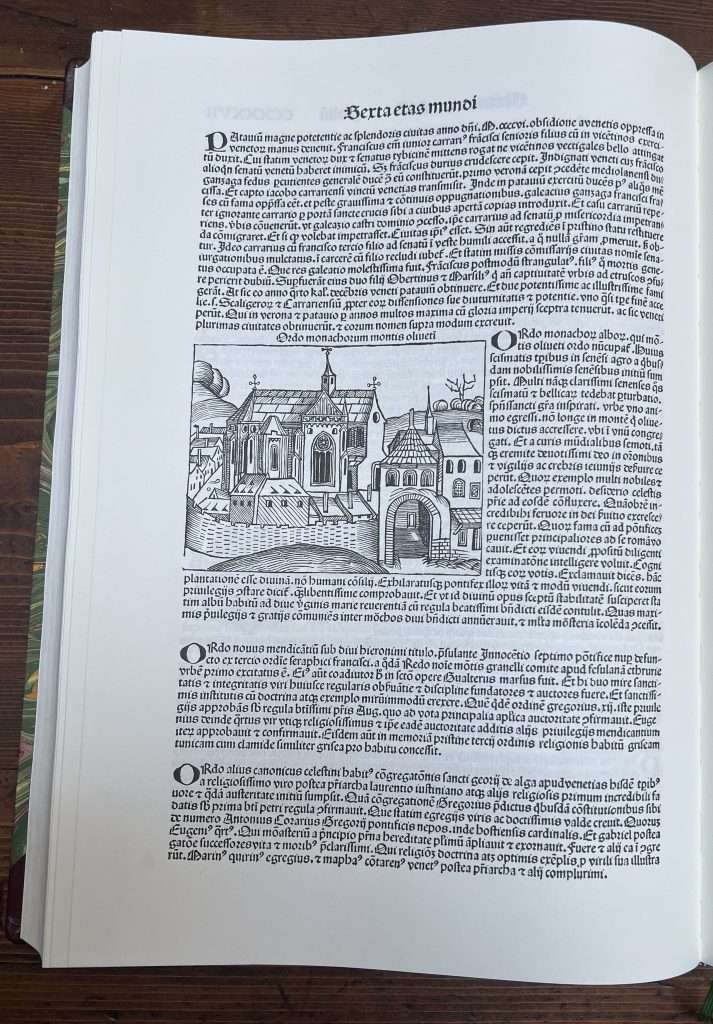
There were maps and descriptions of Europe’s major cities, in this case Florence…
The encyclopedia ran 578 pages…only a few of which, the ones seen here, were first edition and part of the archive in Pienza.
Il Liber Cronicarum has recently been reprinted in its entirety and is available…for a tidy sum…at an art print shop in Firenze.
The first weekend in September in the USA is normally Labor Day, a big holiday weekend. But Carol and Roger would argue that it doesn’t hold a candle to that same weekend in Pienza.
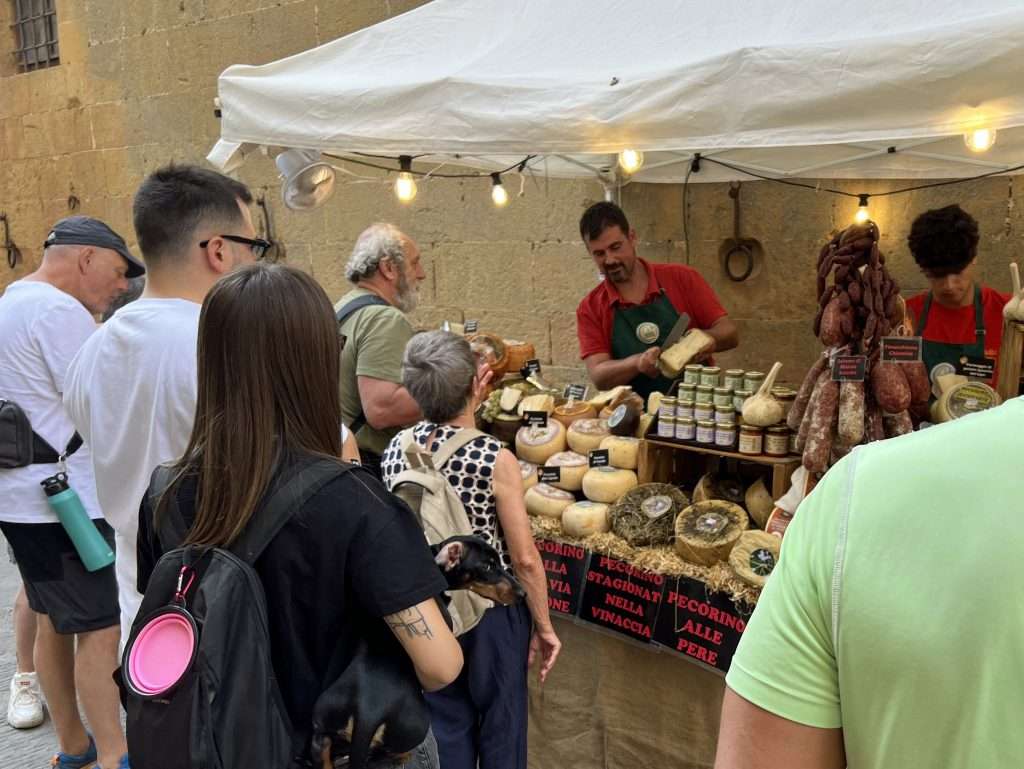
In Pienza, the first weekend in September is the Fiera di Cacio … the Cheese Fair.
Pienza is world famous for its pecorino (sheep’s milk) cheese…a product brought here right after WW II by Sardinian immigrants.
In addition to cheese tastings, the weekend was filled with activities.
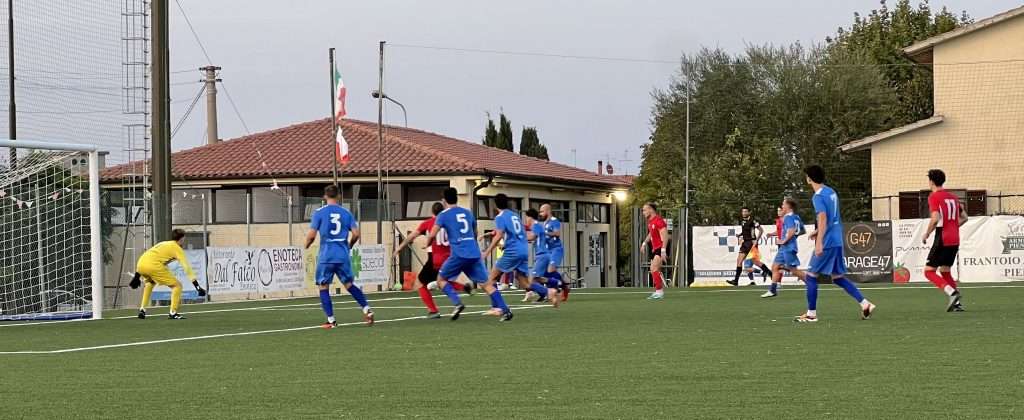
Early Saturday afternoon, the Pientini (the local soccer squad) hosted a “friendly” with the team from Torrenieri. We suffered two critical defensive lapses and lost…a gloomy omen for the upcoming season against more high-powered teams.
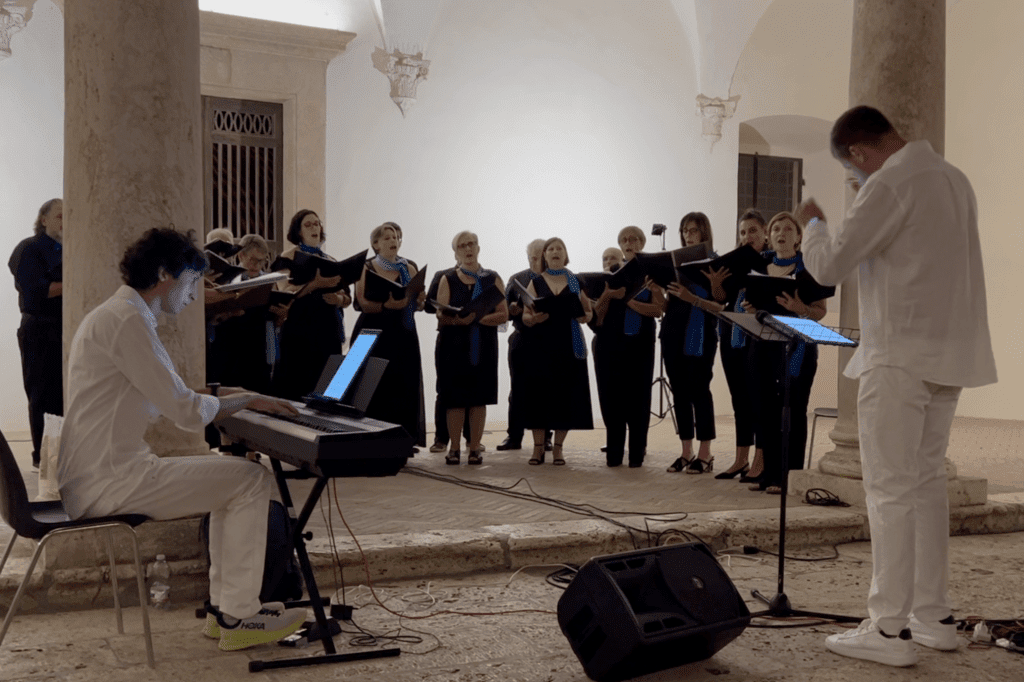
That night, the Pienza Chorus gave a concert honoring the work of Fabrizio di Andre, known as Italy’s “Poet of Music,” who died 25 years ago.
A brief video clip from part of their act: (Click on the full-screen button in the window below to fully appreciate their skill.)
That was followed by the main event…
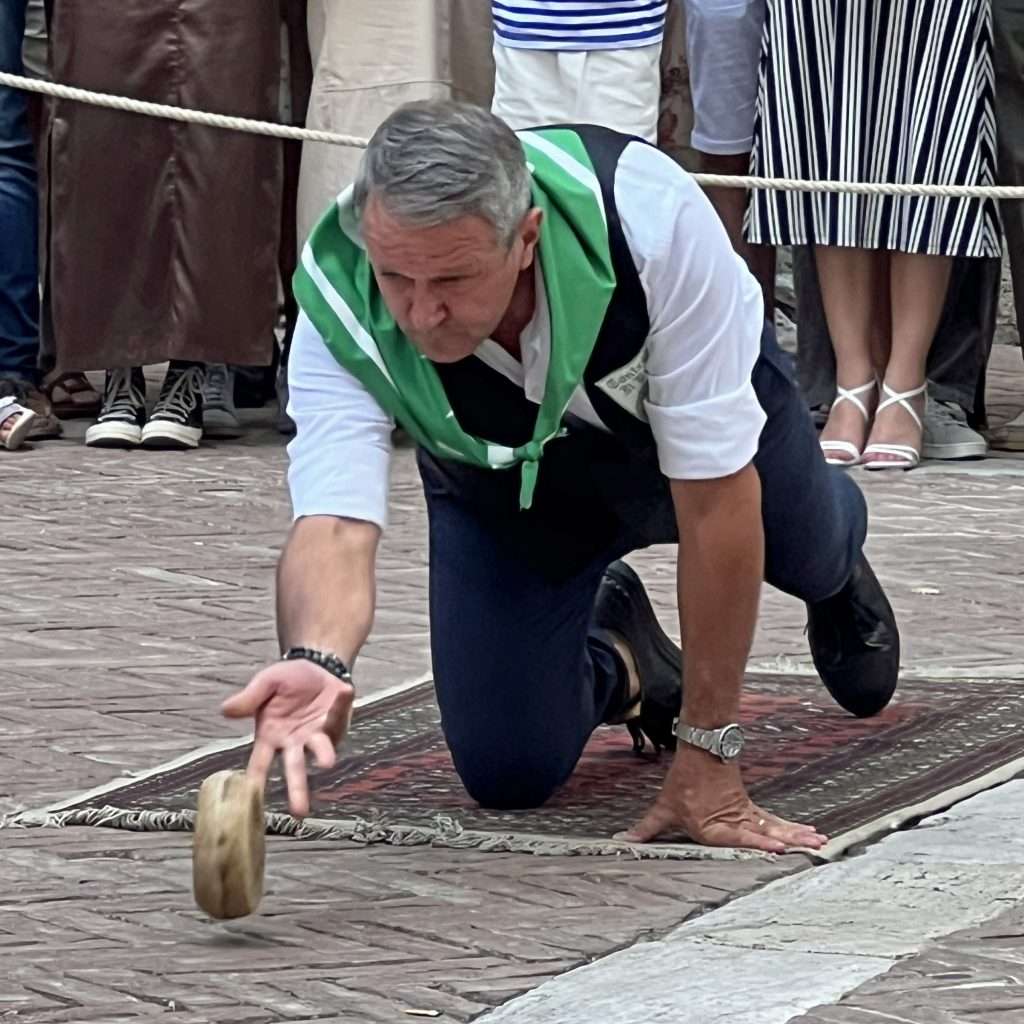
…the rolling of the cheese.
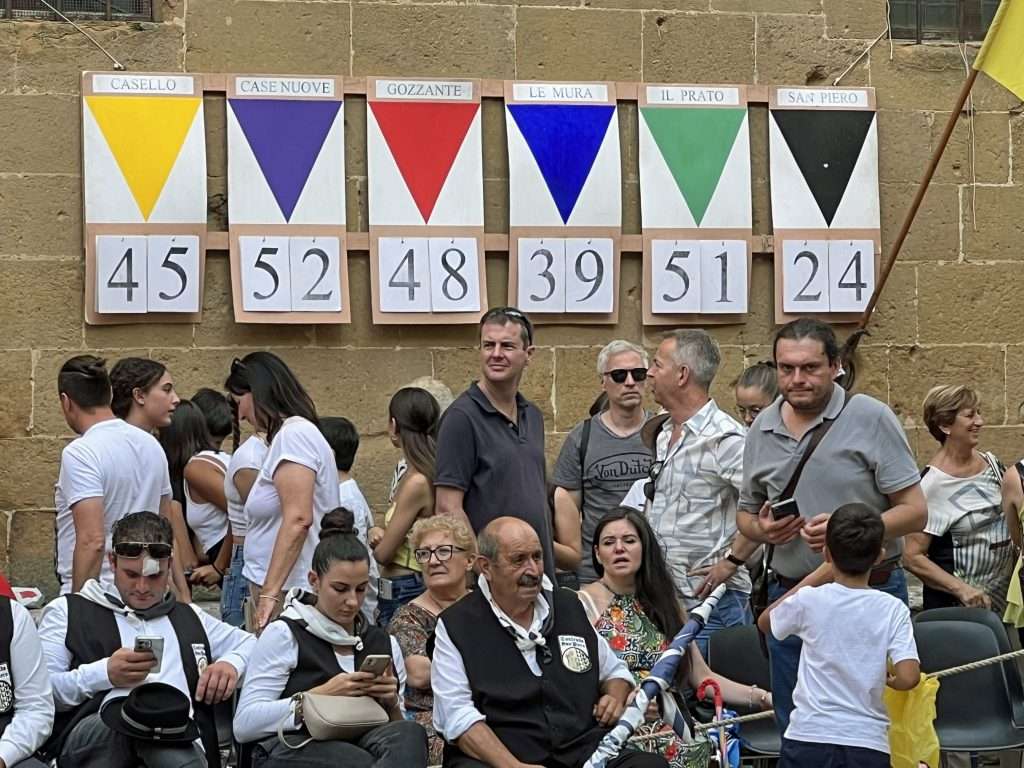
Each contrada (neighborhood) in Pienza sends a team of six for what amounts to a Pientini version of horseshoes. (The closer you get to the pin, the more points you get.) For a description of how the competition works see https://rbergson.org/abbiamo-vinto-we-won/).
It’s harder than it looks since the surface of the piazza is uneven and the cheese does not roll straight. Here’s a look at how it’s done:
Our contrada, the blue triangle didn’t do so well this year.
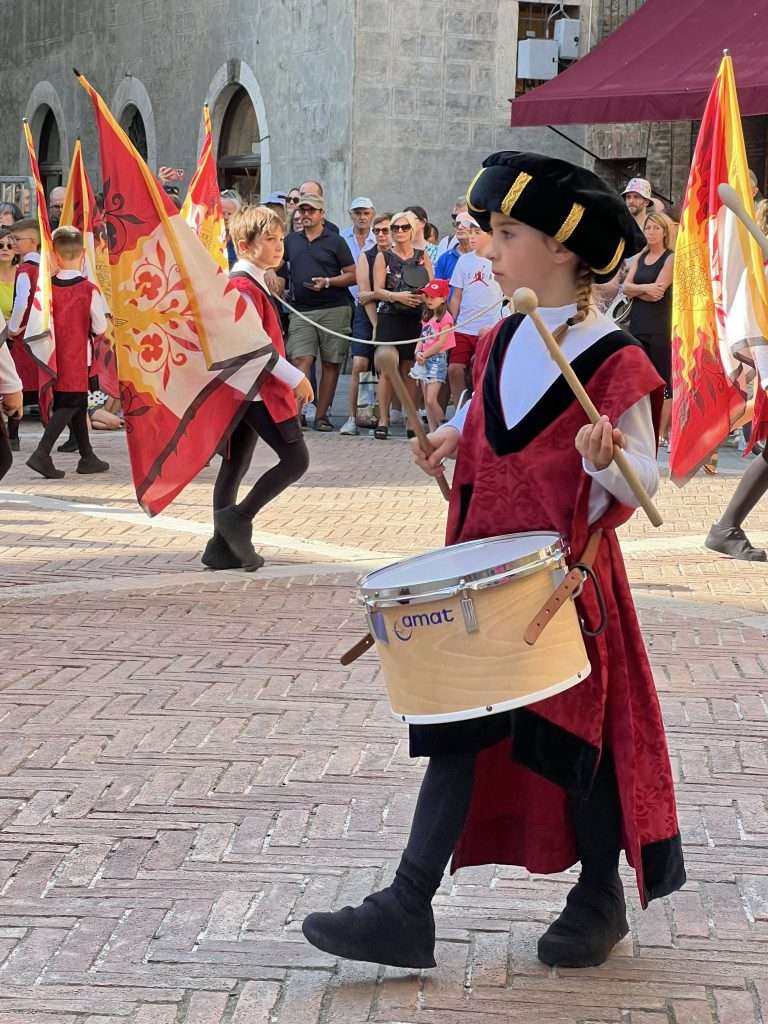
Preserving Tradition
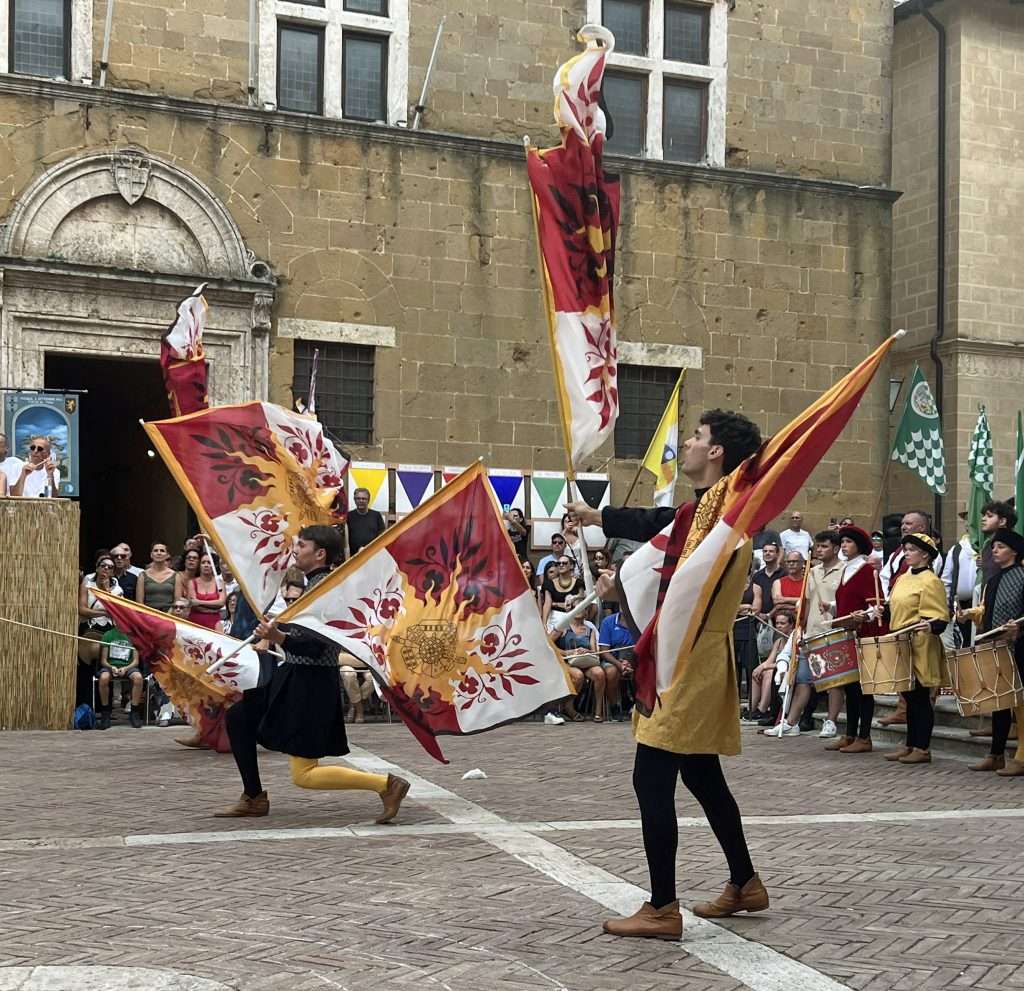
The town has made a concerted effort to keep these traditions alive.
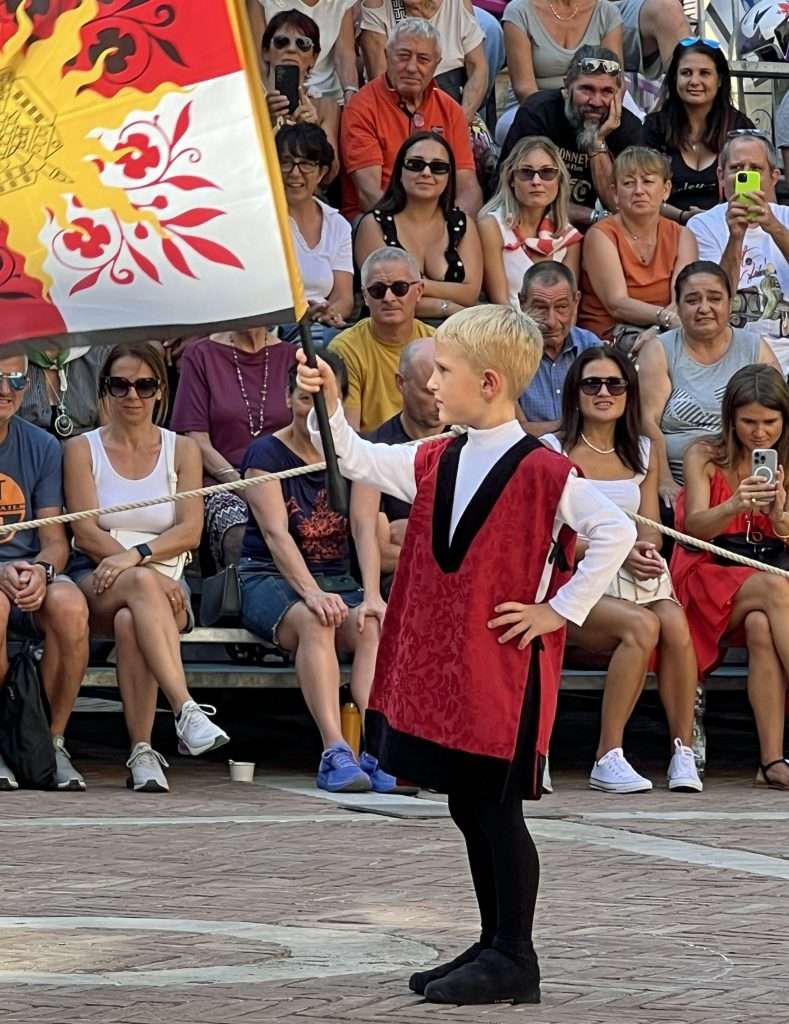
The youngsters in town start early learning to participate in the pageantry.
Carol thought all the youngsters were cute, but this six-yeal-old stole her heart.
Many times, we have shown our blog readers the main piazza in Pienza.
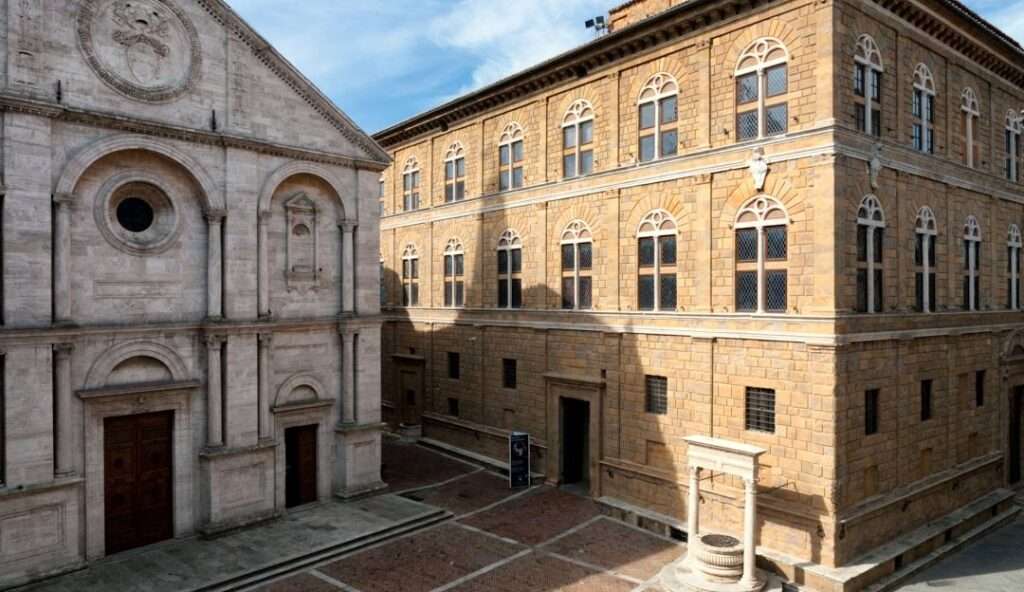
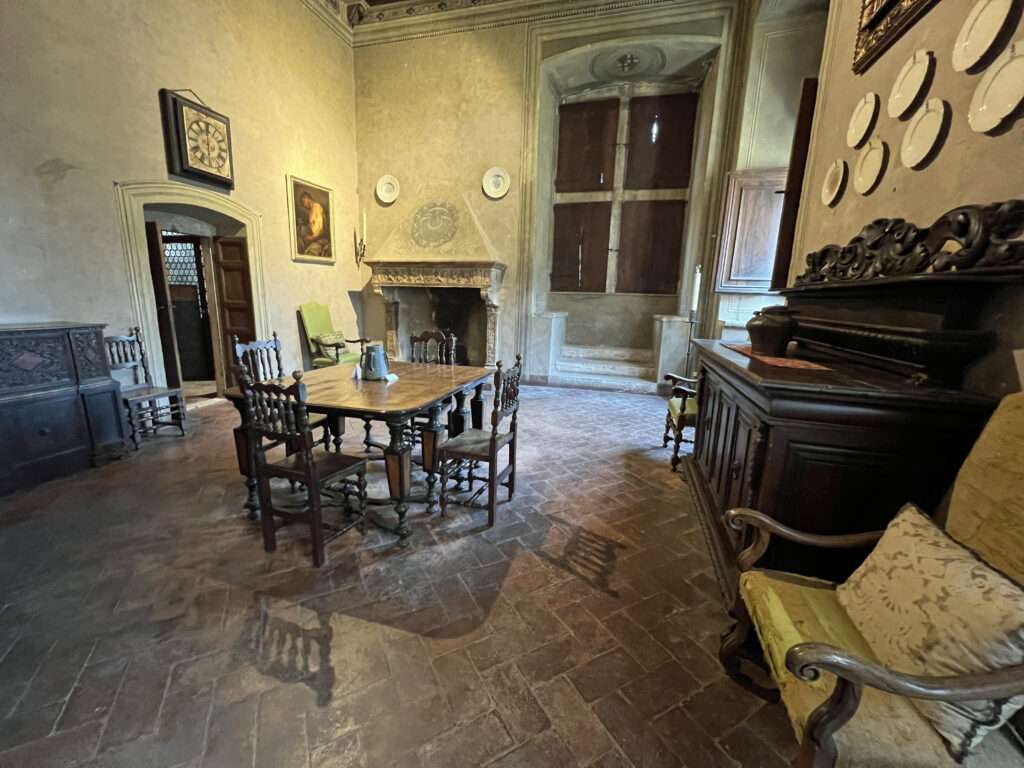
The most noticeable building in Piazza Pio is the duomo (cathedral), built by Pope Pius II in the middle of the 1400’s. But to the right of duomo is the Pope’s personal residence, another building of architectural…and historical…note.
When Pope Pius II was designing the city of Pienza with noted architect Bernardo Rossellino, he ordered his papal residence built on the site of his birth…and the rest of the city designed around it.
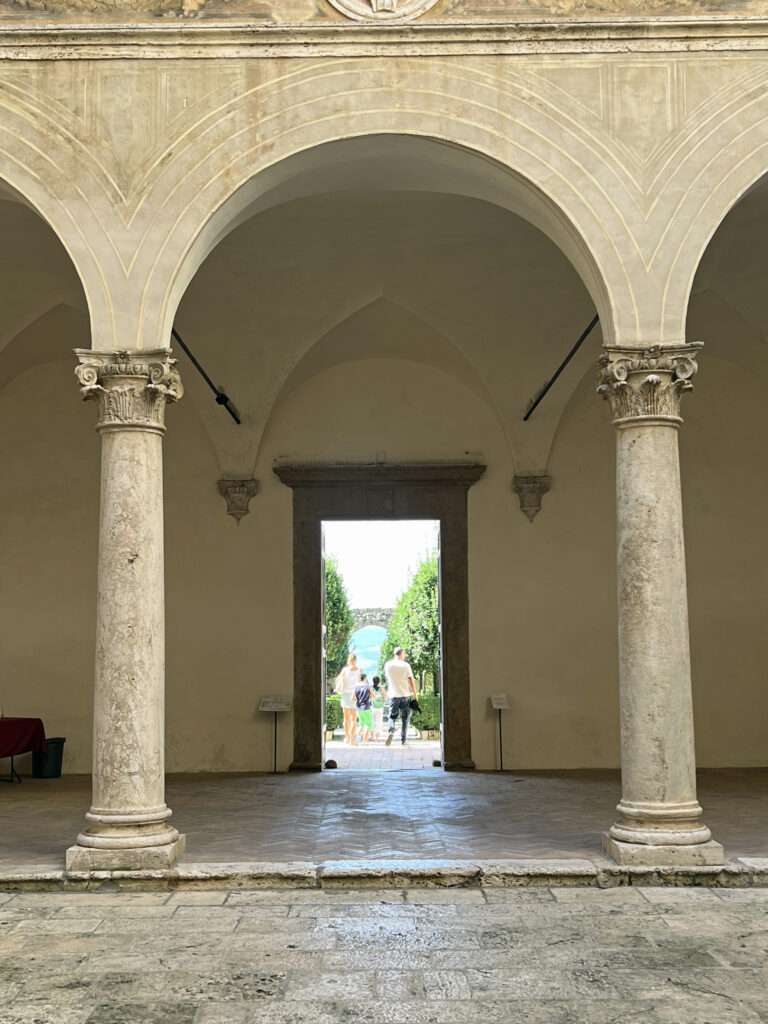
Visitors enter the palazzo into the cortile (main courtyard)
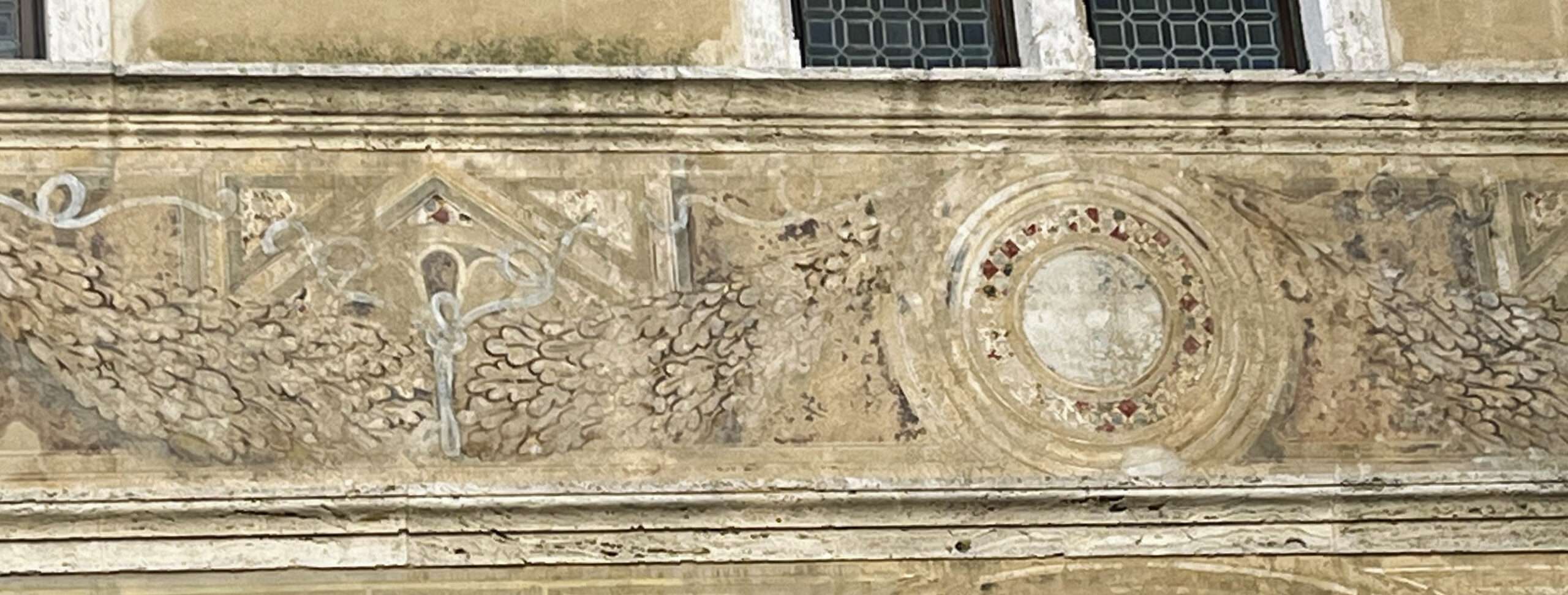
Frescoes that have survived almost 600 years of exposure to the weather grace the walls above the loggia…
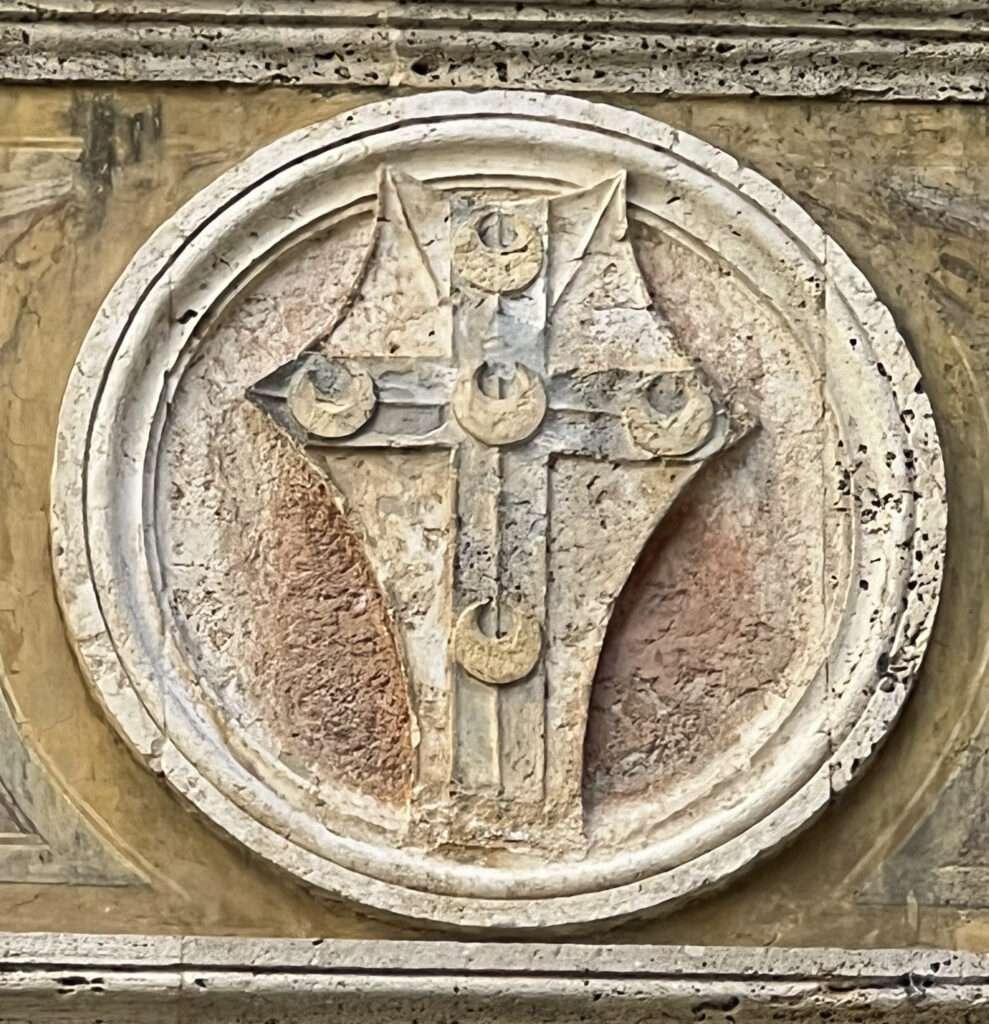
…and the Piccolomini family coat of arms is prominently displayed.
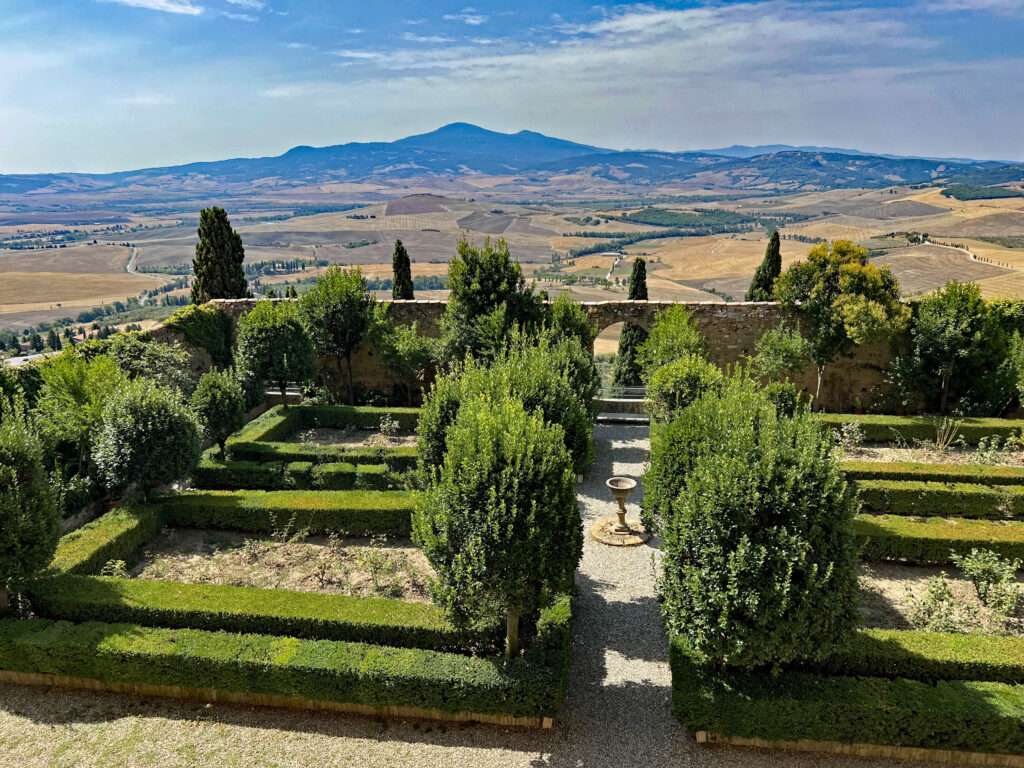
A doorway at the back of the cortile leads to…
…the Pope’s personal garden, with its sweeping view of the Val d’Orcia and Monte Amiata in the distance.
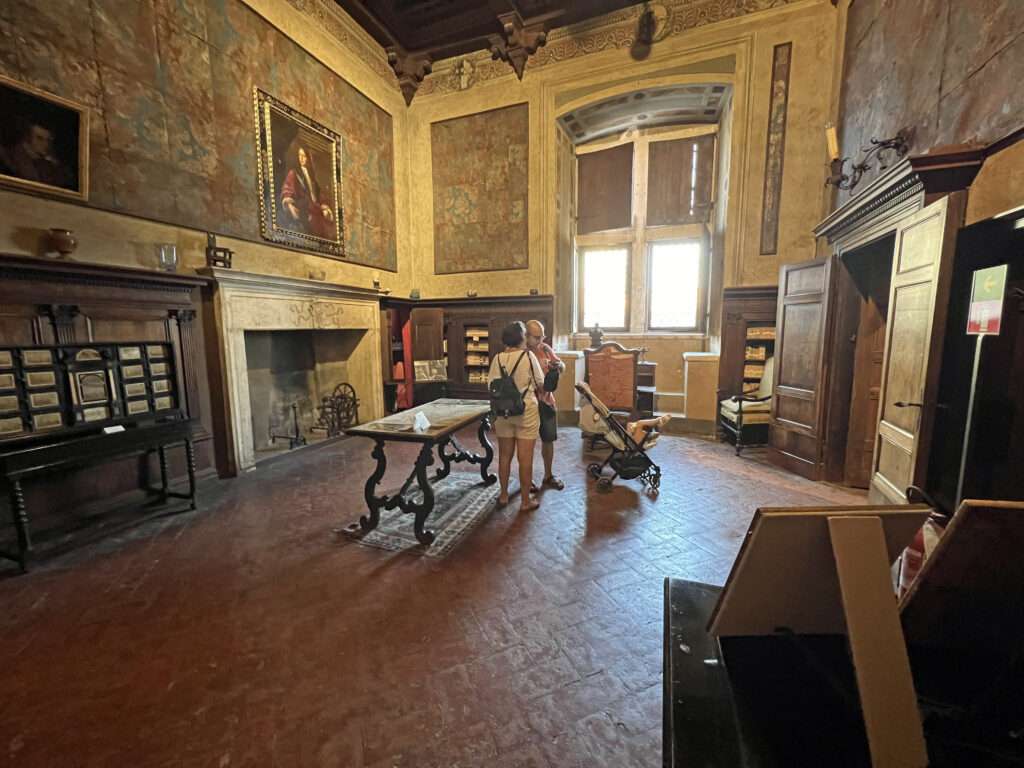
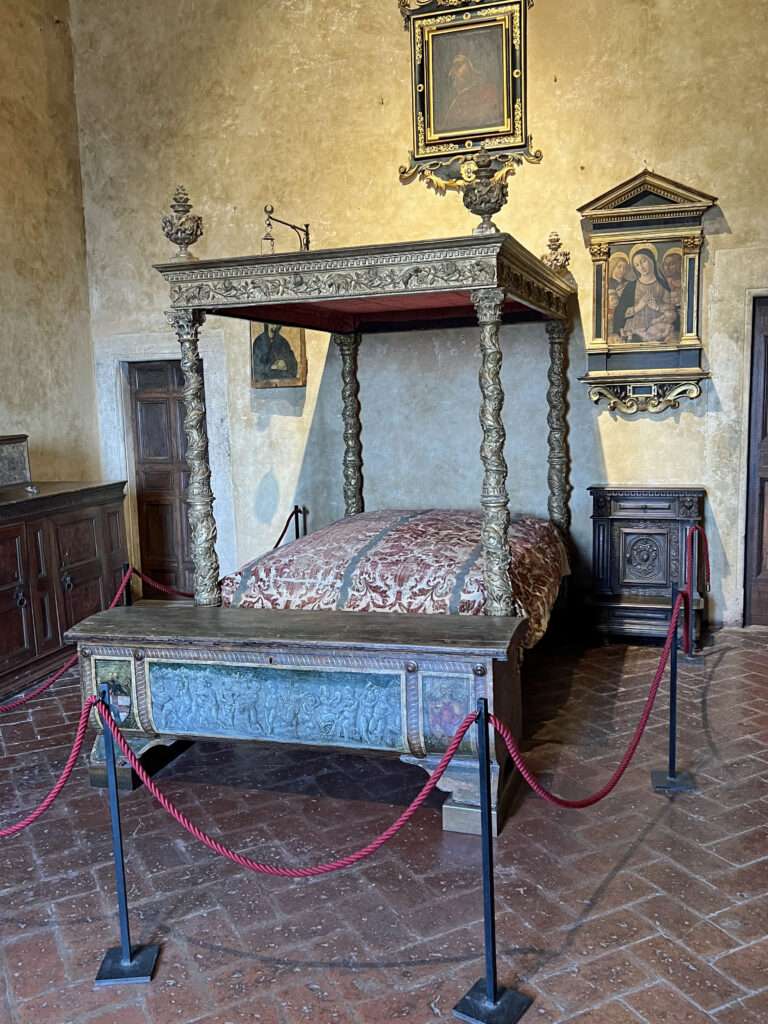
Up a broad stairway to what Italians call the first floor is Pius II’s private residence.
One of the more interesting rooms in the palazzo is the armory, where the Pope’s Swiss Guards mustered and stored their weapons.
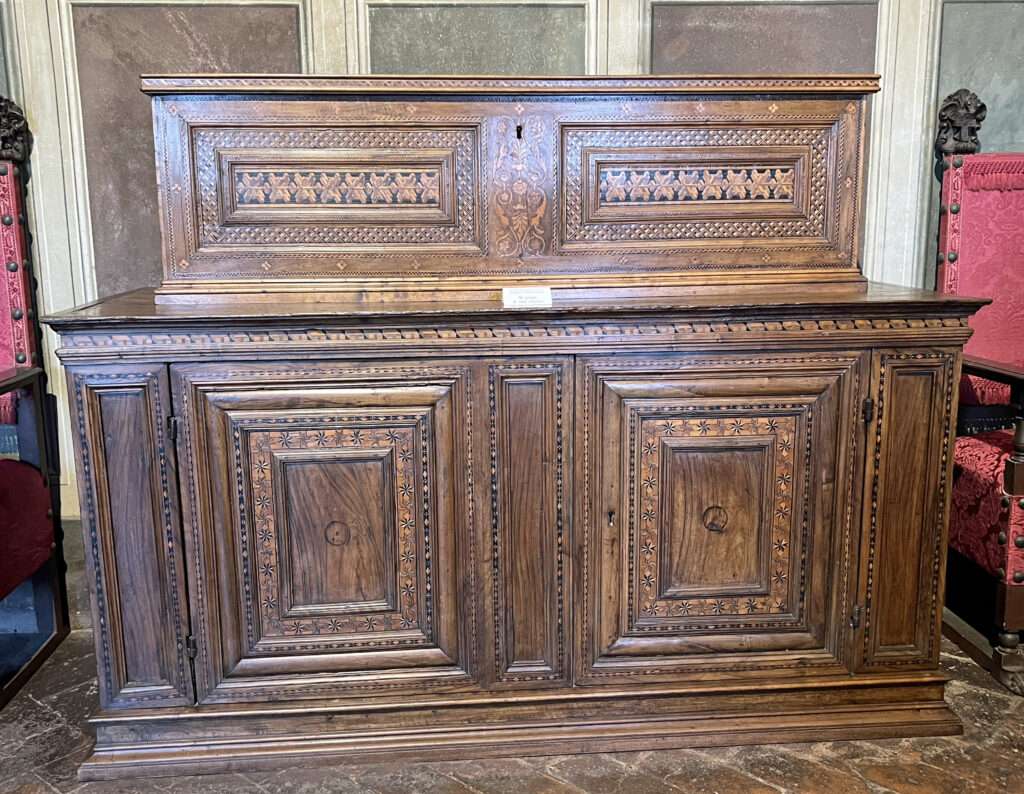
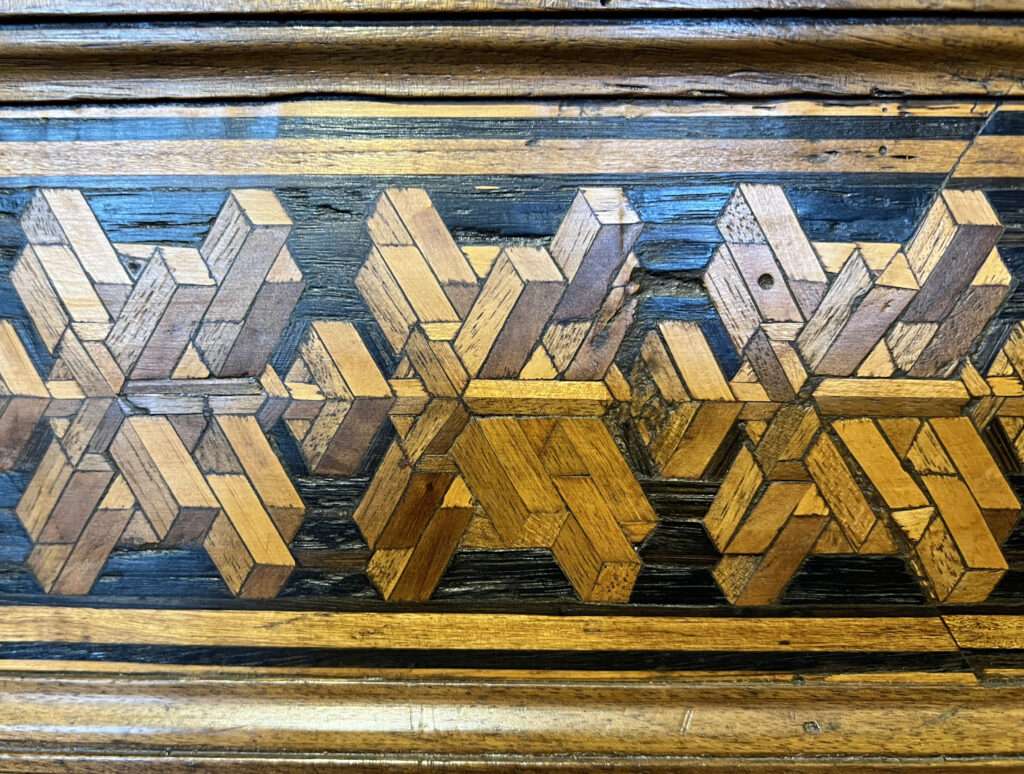
The furniture appears “boxy” to our modern tastes…
but the intarsia (inlay work) is as complex and competent as any furniture-maker could do today.
The public has access to the Palazzo Piccolomini thanks to the man in this 1917 photo.
Silvio Piccolomini was the last of the Piccolomini clan. He spent much of his life restoring the palace and bequeathed it to the city of Pienza upon his death.
His son Niccolo, also shown in the photo, was a pilot in the Italian Air Force…and died in a plane crash during WW II. The street Carol and Roger live on is named in his honor.