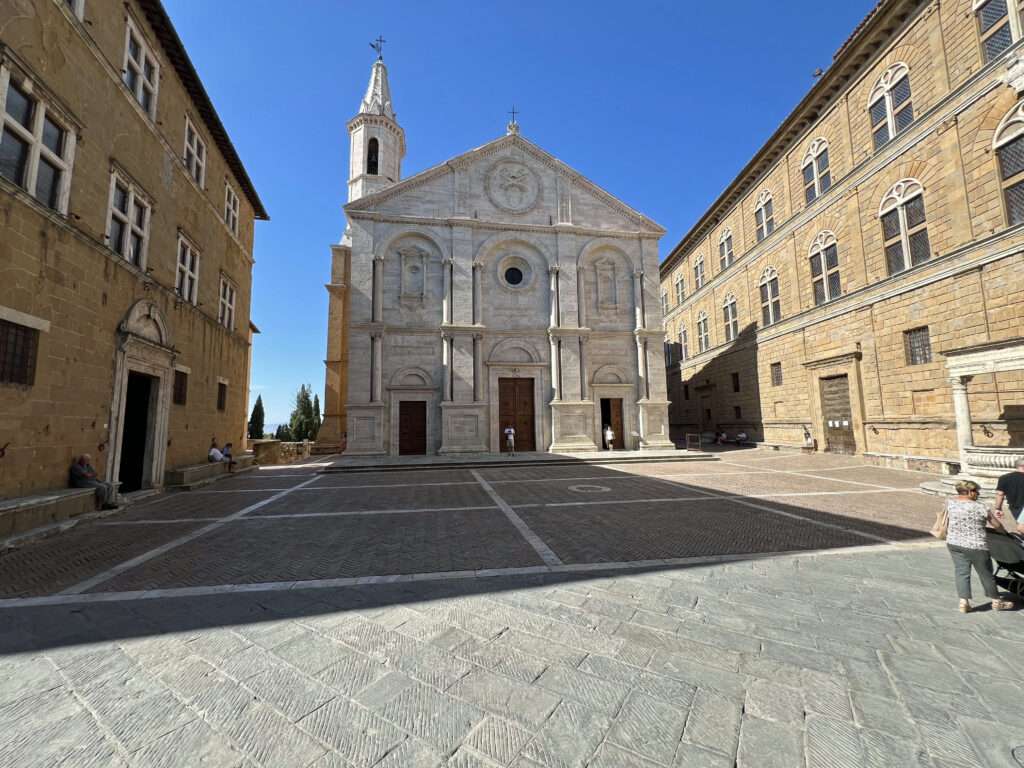
One Summer, a few years ago, there was an electrical storm in Pienza…a common enough occurrence. Carol and Roger were in Seattle at the time and did not know that a lightning bolt had struck a phone line on our street. The resulting power surge blew out appliances in many houses…including any television set or Wi-Fi modem connected to fiber optic cable.
Within a few days the telephone utilities sent out repairmen to fix the lightning damage reported by our neighbors. Since Carol and Roger were in Seattle and unaware of the outage, they never reported their damage. So, the line to Casa Bergson was never fixed.
Carol and Roger returned to Pienza a month after the storm…only to discover their phone line was dead and their Wi-Fi modem was fried. Neighbors filled us in about the lightning strike and told us where to call to ask for repair.
Carol, with the help of a friend, called the TIM…the phone company. They promised to call back within 48 hours to arrange for repair. That call never came. Two weeks later, Carol called the phone company again and heard the same song: expect a return phone call within the next two days. We were less surprised when that call never came either.
Carol and Roger managed to cobble together an alternate system, using their phones as internet hot spots. Cell phone service in Europe is marketed differently than in the USA. Phone minutes are sold separately from data. You purchase one package of phone minutes and a separate package of data (sold by the gigabyte). If you use up all your data, not only can’t you access the internet, but your phone minutes are disabled as well.
This system is fraught with problems. The data purchases, available only in small batches, are expensive. Most frustrating, TIM’s on-line payment system managed to apply our data purchases not to data but rather to phone minutes…which were already fully funded. And finally, on busy tourist weekends, Pienza’s lone cell tower is overwhelmed by demand…meaning internet searches often timed out or streaming video got knocked off-line.
In frustration, we decided to try a different internet service provider. Poste Italiana (the postal service) had good rates and was the only ISP with a representative in town to deal with problems. Carol signed us up. We were pleasantly surprised when, two days later, the modem arrived. Roger plugged it in, fired it up…and discovered it used the same fiber optic cable that had been blown out in the electrical storm the Summer before. Carol went to the post office to report the problem. The postal clerk entered a request for line repair…and told Carol she would get a call setting up a appointment within the next two to three months. The results were similar. The phone call never came. Carol returned to the post office only to be promised yet another appointment. In frustration, we abandoned this option.
This June, when Carol and Roger returned to Pienza, new neighbors next door told us they had gotten a good response from Vodafone when they wanted Wi-Fi and phone service installed. So, Carol and Roger went to the Vodafone store 25 km away in Sinalunga and signed up for their internet service. Carol explained in detail that we needed our line repaired before any service would work. The clerk at the Vodafone store insisted she understood the problem, and her company would resolve it…within two weeks.
It took five weeks, not two, but Carol finally got a phone call from a a contractor for Vodafone…saying they would be out the next day to repair the problem. They actually showed up…on time, no less! For once, this seemed promising.
The repairmen started to work on the problem. The phone jack, where we would connect to the fiber optic cable, was fried. It was replaced. The line where the cable entered the apartment was fried as well. They replaced that too. They tested the outside phone line, where it entered the building. It was dead. They traced the problem to a junction box on the wall outside the house of the neighbor behind us.
When that neighbor emerged from his house, the repairmen asked him if he would open his gate, so they could repair the box on the wall of his building. The neighbor unexpectedly refused and launched into a profanity-laced tirade. The repairman came back to our apartment, shrugged his shoulders (as only Italians can), and said he didn’t understand why…but he did not have permission to access the junction box and so he couldn’t repair what was inside it.
This neighbor had always been friendly. Roger told the repairman he would find out what the problem was. He wasn’t too worried about understanding the neighbor…his English had always proven adequate.
Roger walked around the block to the neighbor’s home. Before he could ask, the neighbor began to rant…first in English, then quickly lapsing into Italian. His response was so rapid and so angry, Roger was only able to grasp a few phrases: “dannato fibre,” “propierta privata,” and “Carabinieri.” The tone of his response, however, left no doubt what he meant: He didn’t give a damn about our fiber optic installation. The box was on private property…his property…and he’d call the Carabinieri to arrest any repairmen who set foot in his yard.
The repairmen called back to their headquarters and were told that without the permission of the property owner, there was nothing they could do. Over the next few days, Carol got several phone calls back from Vodafone. First call: Vodafone was exploring what else could be done. Second call: Their supervisor was investigating legal options to access the junction box. And final call: without the property-owner’s permission, they couldn’t repair the junction box. Did we want to cancel our subscription?
Carol and Roger are constantly surprised by Italian law and the way bureaucracy works. This experience, however, puzzled us in ways we’d never imagined. How could a communications company install a junction box on private property without a guarantee of access to their equipment? How could that same communications company install fiber optic cable in the house next door, but not be able to extend that same line to our building?
Perhaps we’ll never learn after all. Now, we’re back to hot spots with our telephones. But there’s a rub. Every time one of our phone installs an update, the update resets our phones and we have to get help reprogramming them to use them as hot spots. Right now, Roger’s phone is functioning. Carol’s is not.
Oh well.