Some time during the same century Pope Pius II was designing and building the city of Pienza, there was a second…less noticed…construction project going on nearby.
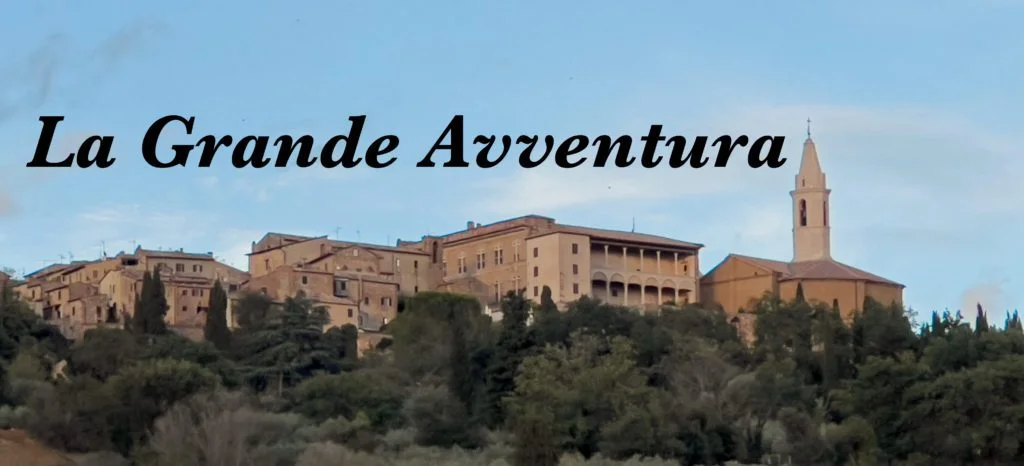
The town of Pienza sits atop a high hill overlooking the Val d’Orcia. The Via Francigenia, the principal pilgrimage route from England and France to the Vatican in Rome, ran through that valley in the 1400’s.


The main stopover spot along this part of the Via Francigenia was Spedaletto, an “ospite,” (root of the English words “hospitality” and “hospital”). But for those looking for a bit more budget-minded lodging, there was this…
It’s called a Romitorio. The Italian word “Romitorio” translates into English literally as “hermitage,” or place where a hermit lives. That, however, was not the function of this place.


Clergy and monks who chose to stay here, rather than Spedaletto, had a place to store their belongings.
There was a cistern to collect rainwater for drinking…

…and several attempts to make the traveler’s stay a bit more comfortable…

At one point, the walls of the Romitorio were frescoed. Fragments of that artwork have survived six centuries of exposure to the elements.
Bas reliefs of the Three Graces once graced the walls of one room.


In another room, there was once a small altar dedicated to a pagan figure…a mermaid with a split tail…commonly seen on churches throughout the Val d’Orcia
You can find her over the doorway of the 8th century church at Corsignano, on the 9th century abbey at San Antimo, and on the 12th century church in Sovana.

A slight digression here…

In Etruscan mythology, this figure is believed to be Scylla, one of the two Sirens who attempted to lure Ulysses and his crew onto the rocks with their beautiful “Sirens’ Song.” By the time the Romans adopted the figure, she had become a goddess of fertility. Early Christian mythology…especially in the Val d’Orcia…attributed her two tails to the moral choice women faced…virtue or sin. And yes, this figure has the same roots as the Starbucks’ logo.
Carol and Roger first heard about the Romitorio years ago and had been trying to visit ever since. But the site is on private property, behind a locked gate, and down a treacherously steep pathway. It is only open to the public a few days a year, when the property owner Carlo Moricciani leads tours.


Carlo’s family has owned the property for generations. Decades ago, when Carlo was a teenager…and even when his father was a teenager…the Romitorio was an out-of-the-way place local teens went to party. Centuries of exposure to the elements did only some of the damage to the artwork at the site. Partying teens did the rest.
Several years ago, the Moricciani family decided to donate the Romitorio to the state as a protected archeological site.
The Ministry of Culture told Carlo’s family they would first have to do an assessment of its archeological value. The family agreed and asked when that assessment might take place. They were told the wait averaged a dozen years. Not satisfied with that long a wait, the Moricciani family set up a private-public partnership to assess and preserve the Romitorio. It’s one of only a handful in Italy…where hundreds of Etruscan and Roman archeological sites await excavation and evaluation.
It’s also proof that if you know how to work the system, Italian bureaucracy can be productive, not obstructive.
If only Carol and Roger could learn how.
Leave a Reply